






 Português
  English (UK)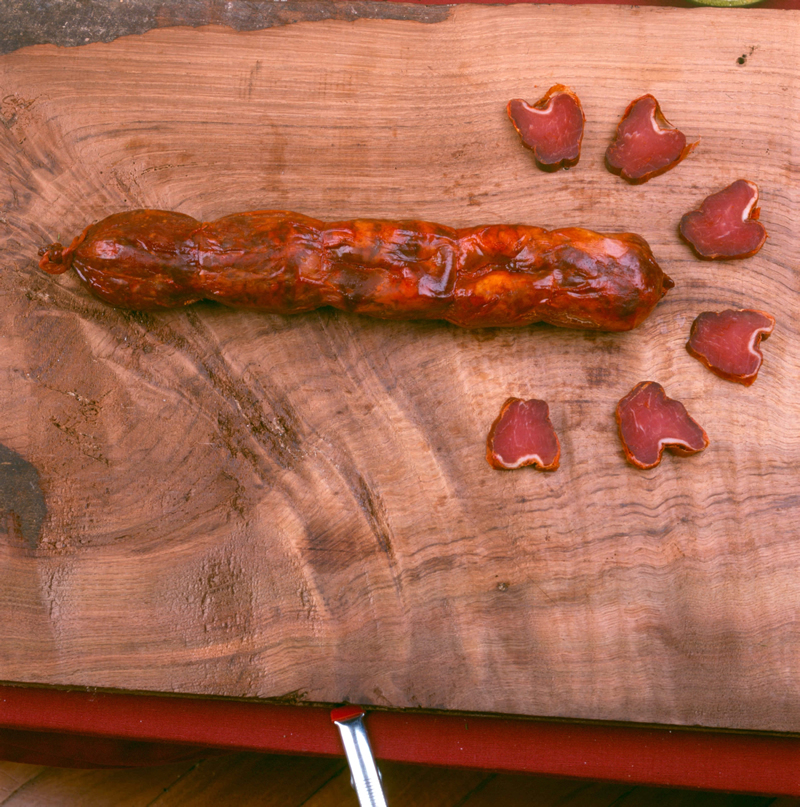
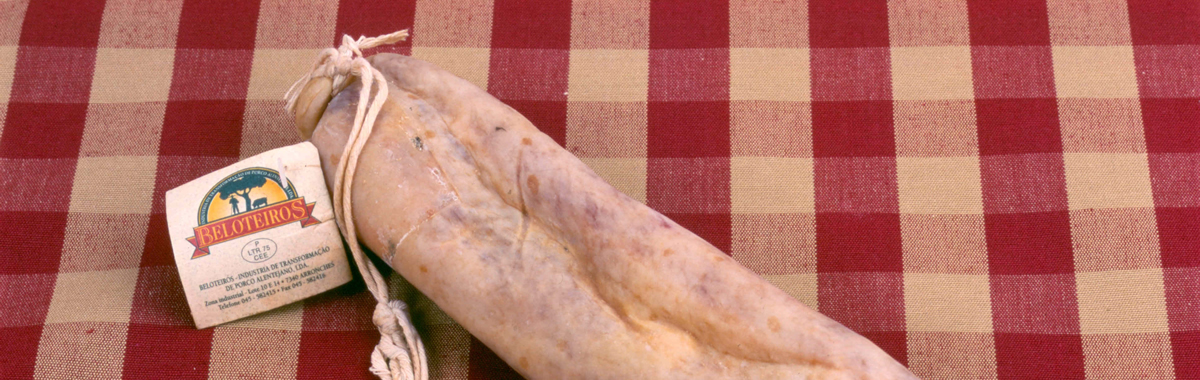
Description: This sausage is considered the high end of all those produced from Alentejo pigs. It is prepared by introducing the entire piece of loin into the casing. It is about 50 to 60 cm long and 6 to 8 cm in diameter. As there are two ways to prepare the sausage, it can be called paio branco or paio vermelho, depending on whether or not it is light pepper.
Region: Alentejo.
Variants: White Barrancos Bread (Loin). Paio (loin) Red from Barrancos.
Particularity: Cylindrical sausage, consisting of a piece of loin and manually tied at both ends. It is a sausage in whose curing process no smoke enters.
History: The sausage shop in Barrancos dates from the foundation of the village, around 1750. Initially it was done in the village of Noudar, where there was a military fortress (ruins still visited today). With its decline, Barrancos grew due to the fact that it had a better geographical situation, which allowed a greater commercial exchange with Spain.
Use: It is consumed raw, being part, along with other sausage shops in the region, of an exquisite entrance. It can also be part of some more elaborate culinary dishes.
Know-how: There are two ways to prepare sausage:
1. A syrup is prepared with water, salt, paprika, pepper and garlic. The loins are introduced and allowed to rest for 48 hours, after which they are introduced whole in the casing;
2. The loins are initially slatted with salt. They are then spread with ground black pepper, nutmeg, garlic and white wine, after which they are introduced whole into the casing. In both processes, the fresh pork casing was previously washed, turned and seasoned with orange slices. After filling, the paios are hung and displayed in rooms suitable for this purpose, where they are subjected to a natural curing process where there is no smoke. Such a process is only possible due to the microclimate conditions existing in the region.
Source: Produtos Tradicionais Portugueses, Lisboa, DGDR, 2001
