


 Português
  English (UK)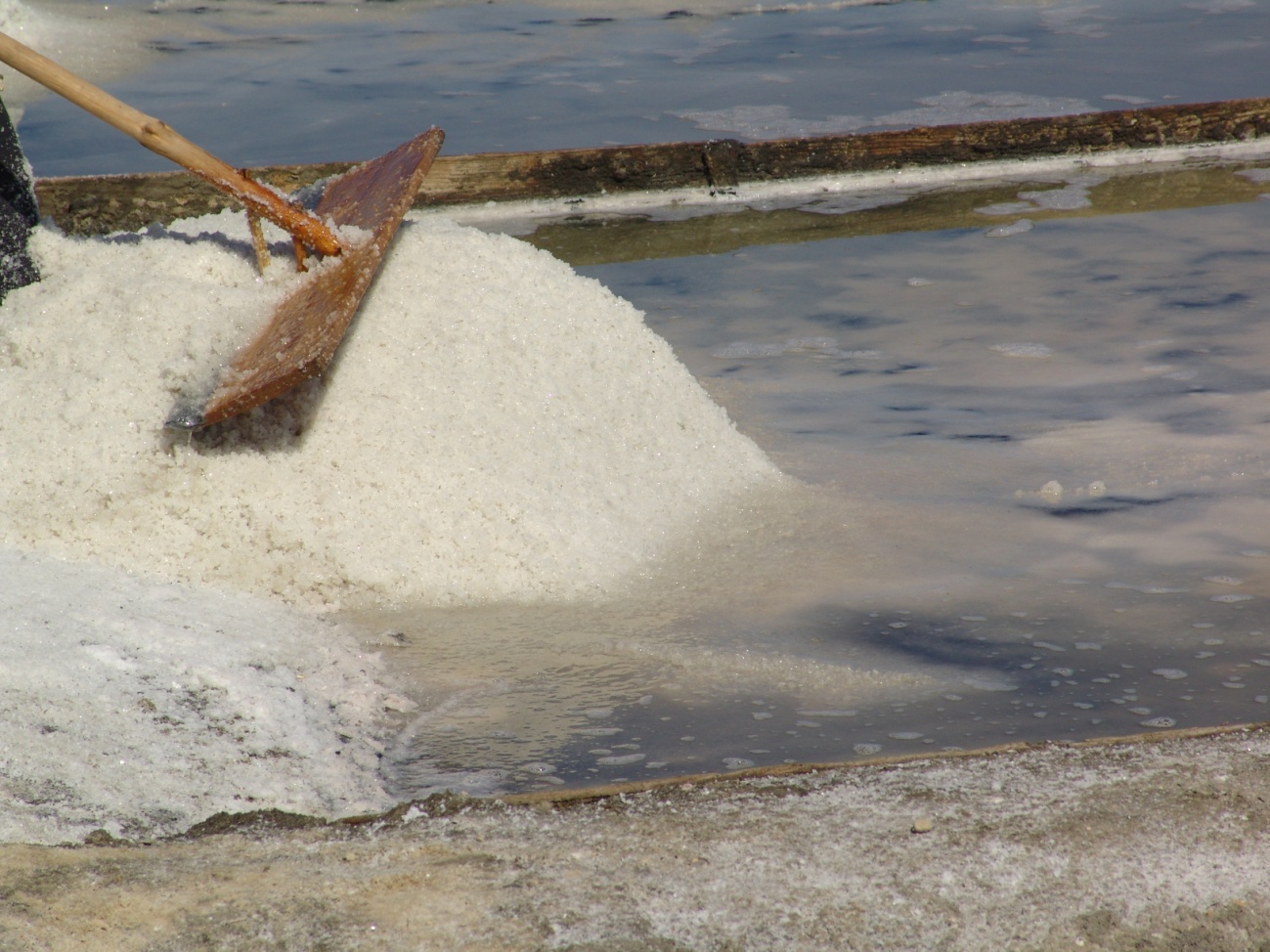
Description: "Sal de Aveiro" and "Flor de Sal de Aveiro" are sea salt obtained by manual harvesting, from the natural process of precipitation of water from the Atlantic Ocean. It is an unrefined sea salt, not washed after harvest and without additives. Both products are characterized by being clean and free of impurities, with a bright white color and a violet aroma. "Sal de Aveiro" has an irregular shape and thick, homogeneous and compact crystals that do not break easily with the fingers. The "Flor de Sal de Aveiro" is composed of small crystals, some of which are arranged in straws, fragile and easy to undo with the fingers.
Special characteristics: The "Sal de Aveiro" and the "Flor de Sal de Aveiro" have unique characteristics that result from their own artisanal production method, associated with the influence of the surrounding environment, namely, the rich biodiversity present in the Ria de Aveiro. The presence of the substance β-ionone in greater quantity, compared to other regions, gives the salt produced in the Ria de Aveiro, a violet aroma. The product is composed mainly of sodium chloride, including other elements such as calcium, magnesium, potassium, iron and iodine, in addition to containing traces of all 84 elements and micronutrients existing in the sea.
Geographical area: Municipalities of Albergaria-a-Velha, Aveiro, Estarreja, Ílhavo, Mira, Murtosa, Ovar and Vagos.
Region: Center.
Production method: The production of salt consists of the process of evaporation of water under the action of climatic factors (sun and wind) that causes an increase in concentration and subsequent crystallization of salts. This activity takes place in the Aveiro region between spring and autumn, in a process that occurs in salt pans that are made up of three groups of tanks: feeding, evaporation and crystallization. The various orders of compartments of the salt pan are arranged on a slightly inclined plane, with the feeding tanks at the highest level and the crystallization tanks at a lower level. Feeding is done every fifteen days with the water from the estuary entering the nurseries that function as water deposits. The gradual increase in salt concentration occurs in compartments, with increasingly smaller dimensions and lower water height, implanted at different levels (from the highest to the lowest level), that is, in the direction of the storage compartments to the crystallizers, where the precipitation of sodium chloride occurs. The "Flor de Sal de Aveiro", also known in the local popular nomenclature as nata or rennet, is made up of the salt crystals that form on the surface of the water during the production of salt. This rennet is harvested daily, carefully and with an appropriate instrument, avoiding touching the bottom of the crystallizers.
Know-how: The artisanal production of salt in Aveiro involves a knowledge of ancestral techniques with their own lexicon and that are passed from generation to generation. These techniques are carried out by the marnotos, using implements, usually in wood, used in the artisanal production of salt.
Forms of marketing: The commercialization is done in local com-mercial establishments in Aveiro and in the salt pans themselves.
Product availability throughout the year: Although it is only mined in late summer/early fall, this product is stored and marketed year round.
Product history: The region of Aveiro was in the past a salt produc-ing center, and its activity grew along with cod fishing. The first record of seapans in the Baixo-Vouga dates back to 929 and refers to the sale of some salt pans located in Dagaredi, current parish of Válega, municipality of Ovar. In the sixteenth century, Aveiro salt prevailed in international markets, essentially used to salt meat and fish. However, during the seventeenth and eighteenth centuries, salt production decreased due to problems with water entry into the Ria de Aveiro and their stagnation. Only in the nineteenth century, with the inauguration of a new water inlet and a new channel to the Ria de Aveiro, the appropriate conditions were created for the production of salt, an increase in the number of salt pans and the revitalization of the salt industry in Aveiro. It is in the second half of the twentieth century that saliculture in Aveiro, then developed by 270 salt pans, goes into decline again. In recent decades, the salt pans have been abandoned or transformed for aquaculture, leading to the near extinction of the activity in the region. Currently, there are about 10 salt pans producing salt, and there is a slight trend towards the recovery of this area with the appearance of new businesses related not only to salt production, but also to tourism activities.
Representativeness in local food: Salice farming is still present in Aveiro and the salt pans, as well as artisanal salt production techniques, are passed on from generation to generation. The production of salt and the Salgado de Aveiro are unique and identity elements, that is, they mark the character of the city and the region, recognized both at local and regional levels, as well as nationally and, increasingly, internationally.
