











 Português
  English (UK)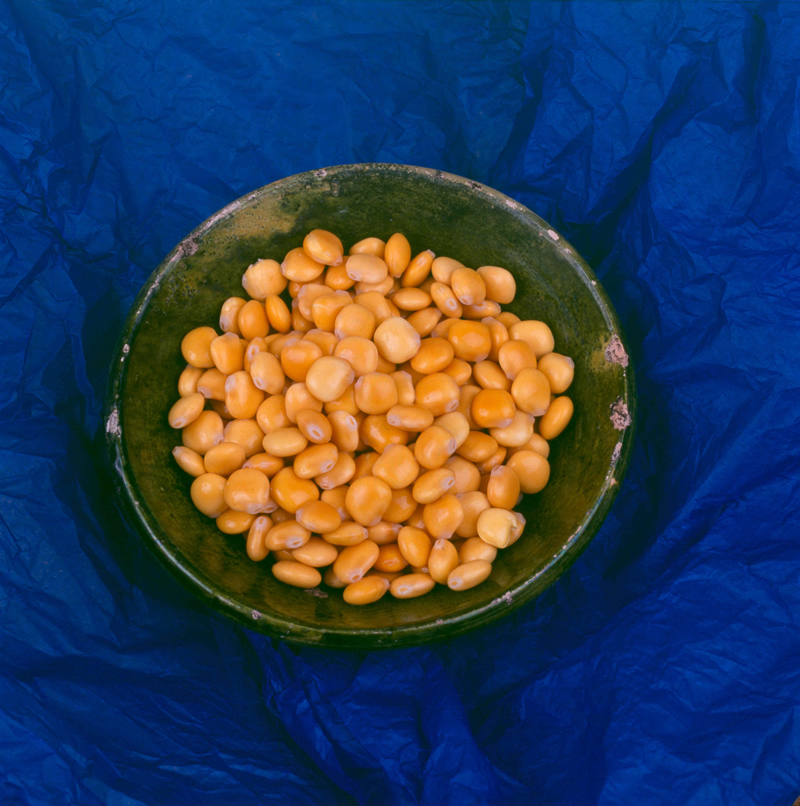
Description: Lupine is the fruit of Lupinus albus L. It is an annual legume, 80 to 150 cm tall. Widely consumed as an accompaniment to beer, after being soaked and salted.
Region: Alentejo.
Special feature: Salted lupine.
History: In the past, the lupine was spontaneous in Portugal. Nowadays it is sown partly to rebury or to ensile as fodder for cattle. It has, however, a large consumption in breweries, serving as an appetizer for beer. It is said in Portugal that the lupine is the «seafood of the poor». Also in certain areas of the center of the country, the bride and groom, at the banns of weddings, usually offer their friends wine and lupins. Legend has it that inhabitants condemned to abandon their land found a field with large lupine bushes that gave them shelter. When it began to be a village, the inhabitants asked the king to give it a charter and that the arms of the village include the only things they had found (sun, moon, stars and lupins) and that it be given the name of Estremoz.
Use: As an appetizer or as a snack, at any time of the day.
Know-how: The crop is, in general, a rainfed crop. It is sown during the first autumn rains, varying the spacing and depth depending on whether the Lupine is intended for fresh manure or for ensiling. In Portugal, in rainfed conditions, it blooms late, in October, having withstood the terrible summer drought extremely well. To prepare ed-ible lupine, several operations are carried out to remove its bitter taste, characteristic of the presence of an alkaloid with poisonous properties. It is immersed in boiling water, remove the water and soak in salted water. These operations are repeated until the lupine does not show bitterness. It remains immersed in salted water, being drained at the time of use. Lupins are packed in 5 kg vacuum packs.
Source: Produtos Tradicionais Portugueses, Lisboa, DGDR, 2001
