


 Português
  English (UK)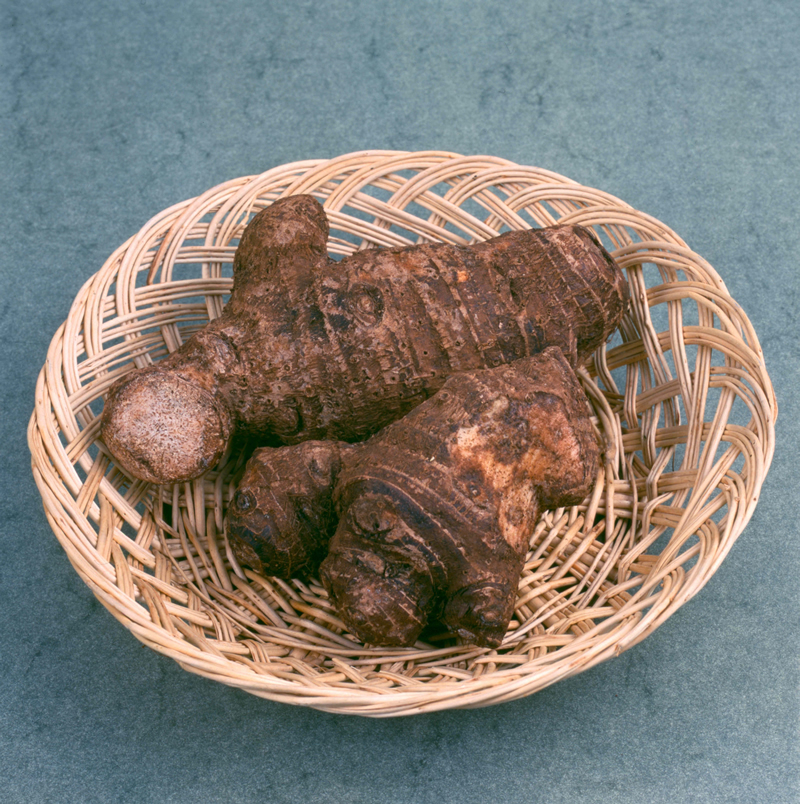
Description: Plant of the Discoreaceae family and belonging to the species Colocasia antiquorum. The leaves are broad and peninergic. It has elongated, tuberculous and feculent rhizomes, which constitute the edible part that is highly appreciated by the local population.
Region: Autonomous Region of Madeira.
Particularity: Food plant whose edible part is the rhizome.
History: This plant, of the species Colocasia antiquorum, has en-joyed a reputation as a food plant since ancient times and seems to have been introduced in Madeira around 1640. Yams were once widely consumed on the island, being one of the common foods used daily, at the appropriate time, by the rural population. Hence it was called the «manna of this land» according to the inscription of 1710 on a stylized table with a slate top and colored inlays, existing in the sacristy of the Church of S. Pedro in Funchal. In the catalogue Cousas e Lousas das Cozinhas Madeirenses there is a report by George Forster (James Cook's companion on one of his scientific expeditions) about Madeira in the second half of the eighteenth century, in which we can read: «... Wherever there is a flat surface on the highest grounds, the indigenous people plant yams... Its leaves serve as food for pigs and peasants use its roots for their own food."
Use: It is a traditional dish preferred during Holy Week. White yam is eaten cooked, accompanied by fish, or as a dessert with sugar cane honey; It is also common to consume fried yams. Red yams are used in soup, which also includes pork, cabbage and beans, and are in high demand in Funchal. The leaves and stalks are used for pig feed.
Know-how: White yams grow in the wettest soils, being uprooted every 2 years, thus producing large rhizomes that can reach 2 or 3 kg. The reds prefer dry soils, originating small rhizomes that are removed from the ground once a year, in spring. To cook them, soak the yams, prepare them and cook them. Usually the hands tend to be "eating" (with and itching). In the field, yams are cooked with less water and sometimes covered with ferns (wild fern) instead of a cloth.
Source: Produtos Tradicionais Portugueses, Lisboa, DGDR, 2001
