







 Português
  English (UK)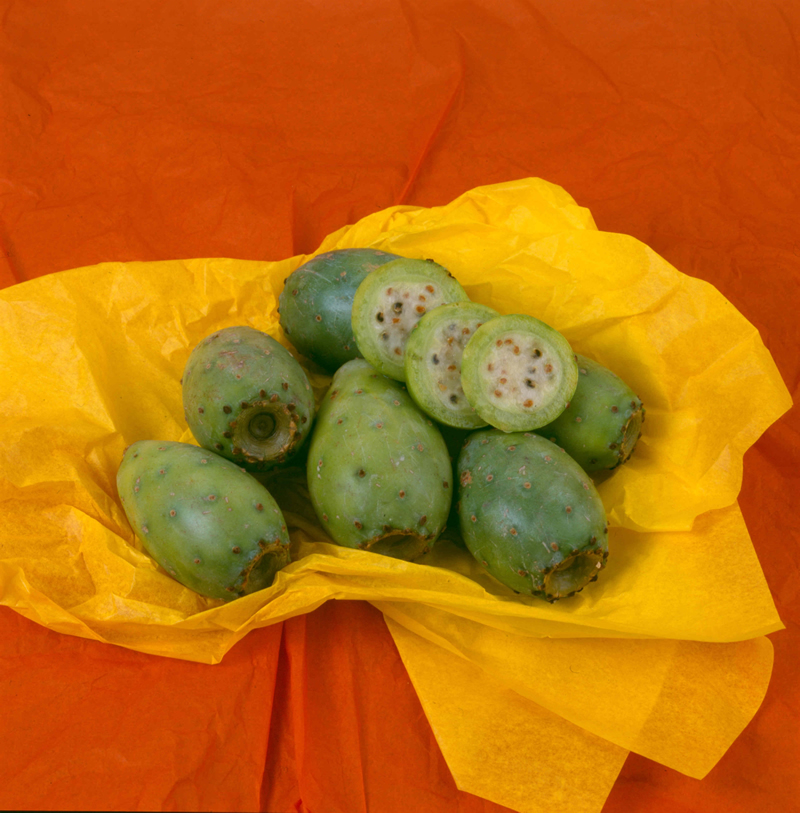
Description: They are the fruits of the species Opuntia tuna Mill, belonging to the cactus family. It has fleshy, succulent branches (commonly known as leaves), at the end of which the figs are arranged. The fruits are baciform, 5 to 8 cm long, and have a high number of spines, arranged in tufts.
Region: Autonomous Region of Madeira.
Other names: Tabaibo. Prickly pear. Devil's Fig. Fig of Hell.
Particularity: Baciform, spinescent, sweet and fresh fruits that have a high number of seeds dispersed in the pulp.
History: Vieira Natividade refers to this plant as being of spontaneous culture, object of wide internal consumption. Eduardo C. N. Pe-reira writes in this regard: «... of Central America, common to Madeira and Porto Santo, which develops and produces on the two islands where it is naturalized». Culture develops better in the interior of the islands, especially with regard to Madeira.
Use: It is consumed with meals as a dessert, or at any time of the day. It is much appreciated fresh and can be kept in the refrigerator after peeling. The branches, after being cleaned of thorns, are good food for the cattle. The shells of the Tabaibos are used to feed the pigs.
Know-how: Tabaibos are harvested from spontaneous tebaiba trees that are found in stony and dry places in the lower and warmer areas. The fruits ripen in the months of July to September. To harvest these fruits, which have a high number of thorns and are in places of difficult access, long sticks are used with a nail stuck at one end, with which the fruit is pricked. A kind of wooden tongs is also used in which the ends are spoon-shaped, which has the advantage of not damaging the fruit. It can also be harvested by hand, protected by a glove. The figs are then placed in boxes with sand and shaken in a back-and-forth motion to remove the thorns. The fruit is sold by the unit, and the price is fixed by the dozen or the dozen.
Fonte: Produtos Tradicionais Portugueses, Lisboa, DGDR, 2001
