


 Português
  English (UK)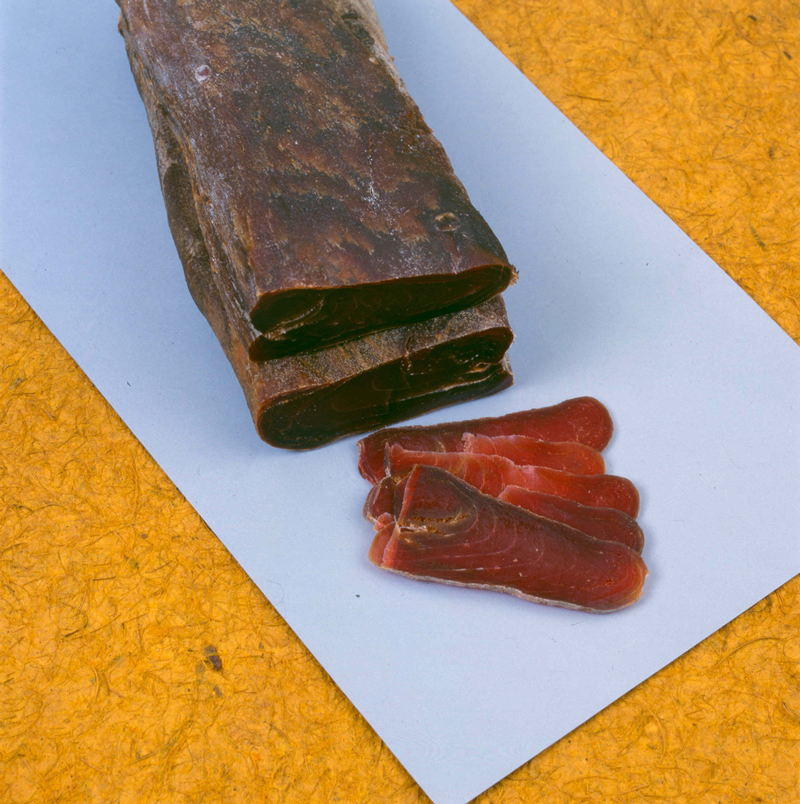
Description: Muxama is made of lumbar pieces of tuna, dry and salted, with a rigid consistency and smooth texture. It has variable dimensions, most commonly about 90x10 cm.
Region: Algarve.
Other denominations: Sea Ham. Mochama.
Variants: Smaller muxama, made of lateral muscle cut belly.
Particularity: Pieces of dried and salted tuna, dark red-brownish in colour.
History: The salting of fish dates back centuries, as a process of preserving food in times of its abundance for food in the winter months when it is not possible to «go to sea». It is assumed that its origin is Phoenician or Greek, since these peoples inhabited the area at times when salting of fish was already common. Over time, and given the quality of the product, it has become a delicacy appreciated by classes with greater financial possibilities, and is now quite ex-pensive. The Illustrated Practical Dictionary of 1944 defines "Muxama" or "Moxama" as a dry, salted strip of tuna loin.
Use: Nowadays its consumption is as an aperitif, cut into very thin slices.
Know-how: Its manufacture is artisanal and based on empirical knowledge. The tuna is headed by cutting and twisting, then giving two longitudinal cuts in the dorsal and ventral parts in order to separate the total muscle masses, highlighting two pieces that are called the trunks and that have a triangular appearance. This operation is carried out by butchers who, in the region, are called ronquedores. The trunk of the tuna undergoes three cuts: a deep one, along the entire piece, to separate the black muscle (the sangacho); a second, not so deep (up to the middle of the muscle mass), which allows the muscle mass to open, but without separating; a third, deeper, which goes from end to end of the muscle mass and parallel to the first two and which separates a muscular strip with the length of the trunk that is called the Muxama. This is followed by salting, done on proper tables, which consists of wrapping each strip in salt, then stacking them on layers of salt, alternately, so that they are completely covered. The next operation is pressing, which consists of placing a plank on the pile and placing weights of approximately 400 kg on it.
These weights are stones (the so-called Borba stones) weighing about 25 kg each. This operation lasts about 48 hours (here lies the first secret of the operation, since the decision to stop pressing depends on the empirical knowledge of the operator). Once the salting and pressing phase is finished, the pieces are washed in various wa-ters. In the first wash, the Muxama is rubbed for better salt elimination. This operation of washing in vats is another of the manufactur-ing secrets, since the producer speaks of 'seven waters', although it has been verified that it actually takes about 5 hours. Once the washing is finished, the drying phase follows, which initially takes place indoors with forced air and lasts 48 hours in winter and 24 in summer. This is followed by outdoor drying that lasts about 15 days in winter and 9 days in summer (in the shade). Following a study carried out by J. Veiga Pinto, a video was made that records all the processing operations of the product.
Source: Produtos Tradicionais Portugueses, Lisboa, DGDR, 2001
