






 Português
  English (UK)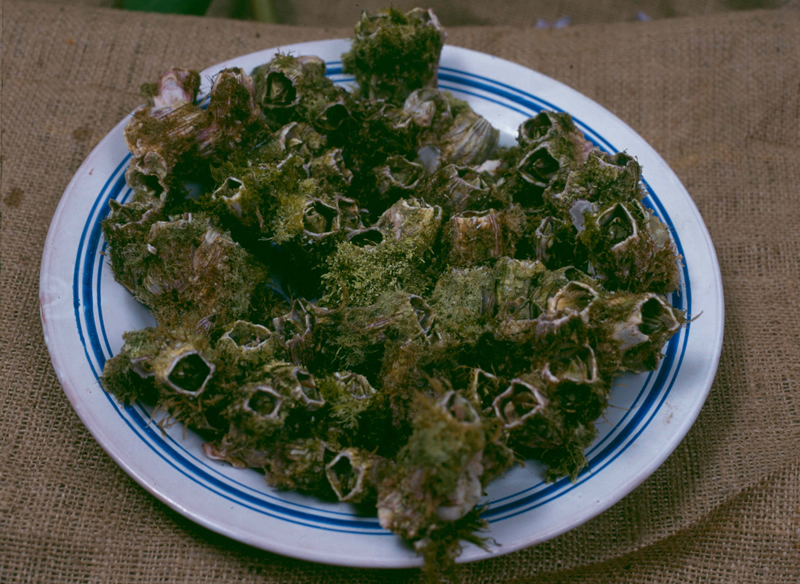
Description (dimensions, color, aroma, texture): The barnacle, a limestone formation, cocoon-like attached to the rock.
Definition of the geographical area of production: Autonomous Region of the Azores.
Ingredients used: Barnacles; onion; parsley (branch); garlic (clove); Chili pepper; seawater.
Preparation: Choose the barnacles and reject the matches. Remove loose limescale. Gently wash the barnacles with seawater and set aside. Peel and quarter the onion and set aside, crush the garlic and set aside. Wash the parsley, even in a sauce and set aside. Place in a saucepan, cover with water and let it rest. Place the pan on the heat, and bring to a boil. When it boils, add the remaining ingredients and boil for about 15 min. After that time, turn off the heat and let it rest for about five minutes. Remove the barnacles with a slotted spoon and let cool. Serve cold. In the tasting, after removing the crustacean from the interior, which is done using a small hook, it is advisable to drink the water from inside the niche where the crustacean was located.
Product history: Wrongly considered a mollusk until the mid-eighteenth century, at the end of the nineteenth century and after scientific confirmation, it is now accepted that the barnacle is a crustacean belonging to the Cirrípedes family. This small marine crustacean soon after its birth (about 4 months) attaches itself to a support (rock) and spends the rest of its life there. Immobilized on the support, it feeds on organic matter suspended in the water around it, through the flexible limbs with which it explores them. It lives in large colonies, usually up to 10 to 15 meters deep, and in some cases can reach 30 meters. They are caught on the coast, in freediving between 3 and 10 meters. Surfaced at low tide, it can survive thanks to its protective plates in the hole at the top of the cone that closes, conserving water inside. Hermaphrodite or bisexual, about 97% of species can fertilize individually, with a direct relationship between the amount of food and the average life span inversely proportional.
Source: Federação Portuguesa das Confrarias Gastronómicas
