



 Português
  English (UK)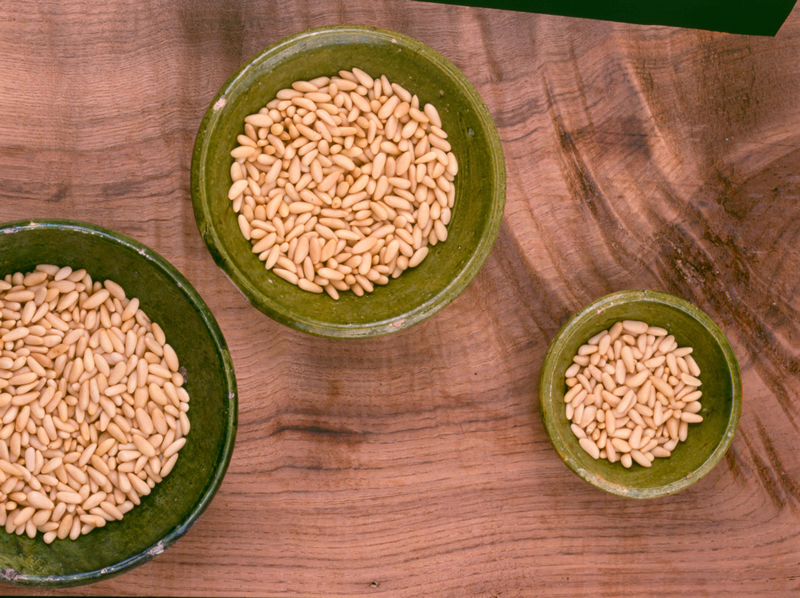
Description: The pine nut kernel is obtained from the seed of Pinus Pinea L, of the Pinacea family. It has an ivory-white color, well marked, without any defect or smell, and the flavor is characteristic. The average dimensions of the pinion core are between 13 mm and 5,3 mm, with a length/width ratio of around 2,47.
Region: Alentejo and Lisbon and Tagus Valley.
Other denominations: Miolo de Pinhão de Alcácer do Sal.
Particularity: Peeled pine nut kernels, with a characteristic ivory-white color, particularly tasty, due to its method of obtaining and preparation.
History: The consumption and trade of pine nuts have always been of particular importance in the region. The introduction of machinery to facilitate the breaking and hulling of the seed has further increased this activity. The importance of the trade in pine nut kernels was such that it was called 'white gold'. Like other dried fruits, the pine nut was already used by Portuguese navigators at the time of the Discoveries, given its high conservation capacity and its energy value. The traditionality of the consumption of pine nuts is easily proven by its use in the oldest recipes of regional and traditional Portuguese sweets.
Use: The pine nut kernel is much appreciated as an aperitif, but it is also used in traditional confectionery, such as pine nuts. It is also used in some culinary dishes, as an ingredient in various rice and salad recipes.
Know-how: The pine nut kernels come from stone pine forests where, traditionally and practically, phytosanitary treatments or fertilizers are not used during the growing season, which may give it the right to use the term "Organic pine nut". The pine cones are harvested from the first day of January and then placed in the sun, on threshing floors. The whole work of picking the pine cones is particularly interesting, highlighting, for its primitiveness, the instrument used by the pickers to climb the pine tree. Once picked, the pine cones are opened under the action of solar heat or, when this is not possible, the opening is forced by the application of dry heat (ovens) or water vapor. Once opened, the pine cones are shaken to obtain the pine nut in shell. The pinion nut in shell is subjected to manual or mechanical crushing, and then appropriate screens are used to separate the core from the shells. The kernel is washed and dried in hot air ovens, usually obtained by combustion of the pine nut shell and pine cones. Then, and to maintain the uniformity of color of the batches, the pinion passes through electronic separators. Subsequently, and as a final stage of the process, the manual selection is made in order to ensure the quality of the various batches. The core is finally packed in plastic bags of 125 g, 250 g, or 1 kg, with or without vacuum.
Source: Produtos Tradicionais Portugueses, Lisboa, DGDR, 2001
