


 Português
  English (UK)
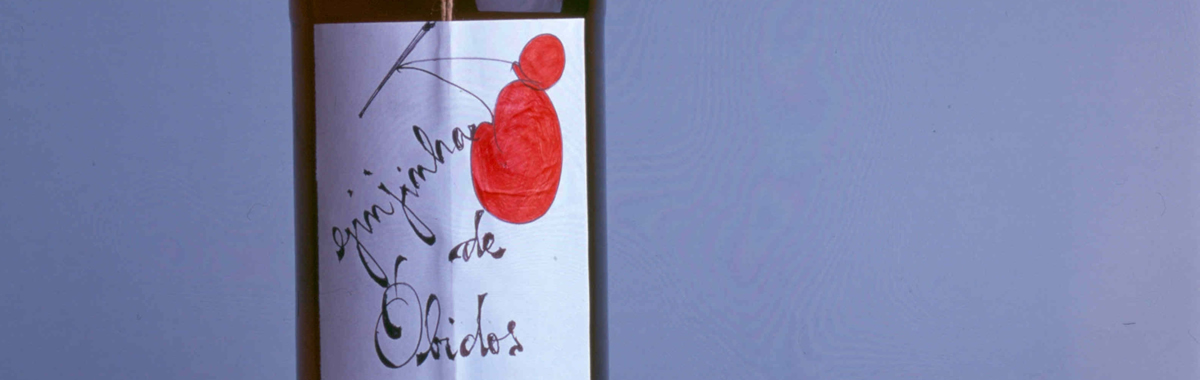
Description: Made with ethyl alcohol, sour cherry of the Galega variety, originally from the region, and sugar. No dyes or preservatives. The liqueur, dark red, is presented on the market in white glass bottles, conical in shape and with a capacity of 0,5 liters. The pyrographed label is hand-painted, has a choker and back label indicating the ingredients. The cork stopper is made of cork.
Region: Lisbon and Tagus Valley.
Other denominations: Licor de Ginja de Alcobaça.
Special feature: Liqueur with a strong sour cherry flavour, presented in glass bottles, conical and with a pyrographed label.
History: The Ginja de Alcobaça is a traditional conventual liqueur, resulting from ancestral recipes of friars and nuns who, in the region, made school in the various monasteries (Alcobaça, Cós, S. Miguel, Batalha, etc.). The current confection formula belonged to Mr. Manuel de Sousa Ribeiro, an industrialist who lived in Valado de Frades, in Nazaré, and was later acquired by David Pinto and Joaquim Belo Marques da S., both residing in Alcobaça. It is currently owned by the firm David Pinto & Companhia, Lda., in Alcobaça. The registration of the bottle model dates from November 17, 1930, by Mr. Manuel de Sousa Ribeiro, and was designed and executed by Sociedade Carlos Campeão, Lda., from Alcobaça (extinct). The registration of the first label dates from March 17, 1930, with only the initials MSR inside a diamond. The registration of the second and current label was transmitted on March 28, 1942 to David Pinto and Joaquim Belo Marques da S. and later (April 22, 1952) transmitted to the current company. It is curious to note that, for the processing of 500 kg of sour cherry, 11 women and 1 man are needed.
Use: As an aperitif or digestive, at any time of the day and night.
Know-how: Since the cooking formula is a well-kept secret, the following can only be indicated: the ingredients are Galega sour cherry, from the region of Sobral da Lagoa, in Óbidos, alcohol and sugar. The sour cherry is cleaned of stems and leaves, pitted (with the aid of an appropriate machine) and placed in 200-liter barrels. Then add the alcohol, stirring very well with a stick (stick). It ferments for 4 months and is stirred every day with a whisk. At the end of the 4 months, the fruit is squeezed by means of a manual press. Batches are then formed for their composition (addition of sugar), filtering and bottling. Initially, the liqueur was made with wine brandy, but, given the fact that the final product always has a certain flavor of brandy, ethyl alcohol was chosen, which does not take away the flavor of the fruit.
Source: Produtos Tradicionais Portugueses, Lisboa, DGDR, 2001
