








 Português
  English (UK)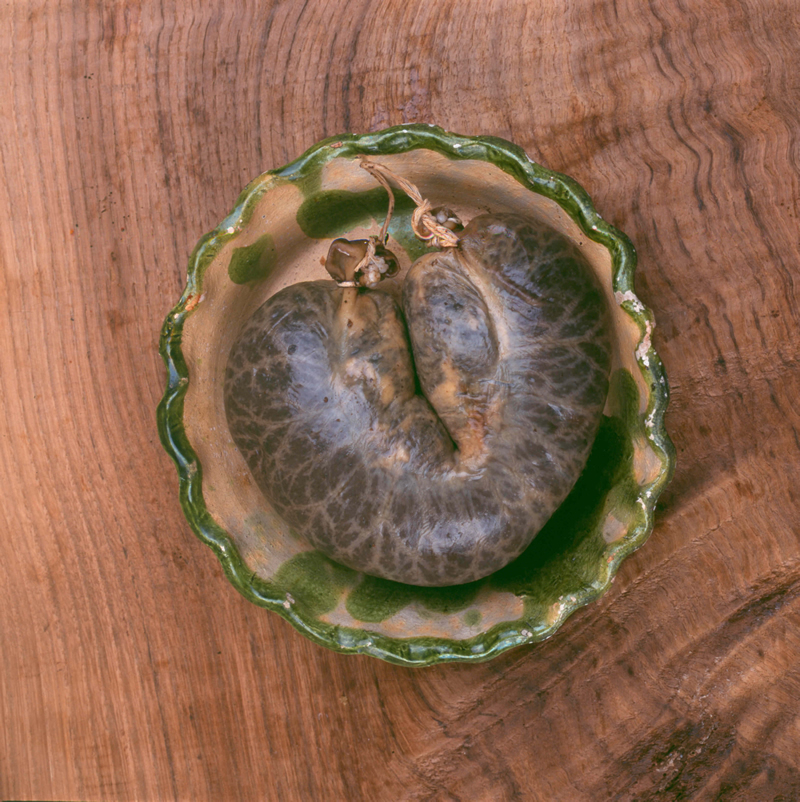
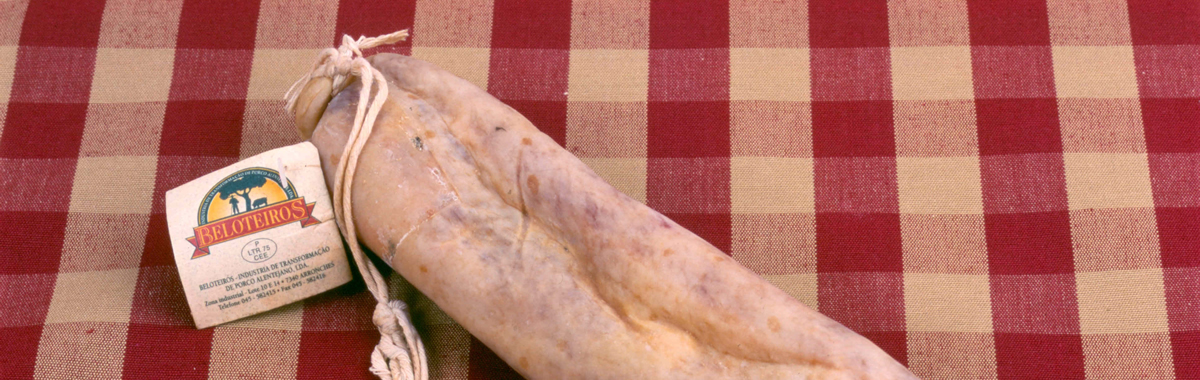
Description: The Black pudding of the Guard weighs between 300 to 400 g and has a length (when stretched) of 35 to 45 cm and a diameter of 5,5 to 6,5 cm. They are presented in the form of a horseshoe, with a medium consistency. The interior mass is homogeneous and cohesive. When cut, it produces slices with a compact appearance. not deformed.
Region: Center.
Special feature: Dark-coloured and horseshoe-shaped sausage, with a smooth outer texture. Made from pig's blood and wheat bread, it has onion and paths as ingredients.
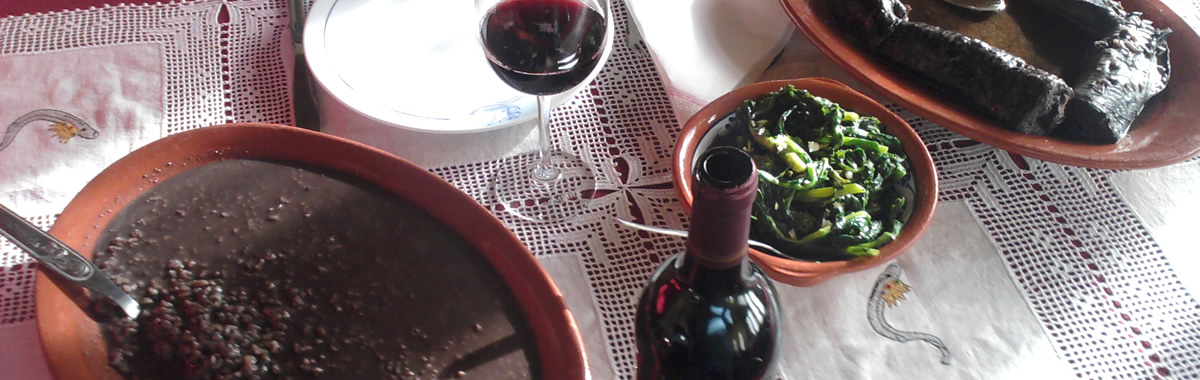
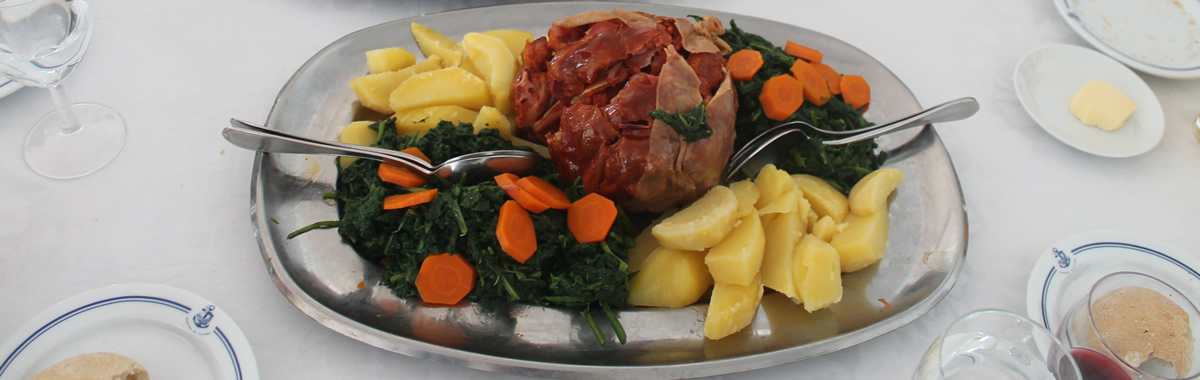
Use: Morcelas da Guarda are eaten fried, sliced, accompanied by boiled potatoes and boiled turnip greens (cabbage or turnip), or in the Portuguese stew. They can also be eaten boiled or roasted (when fresh), as a starter.
Know-how: The blood is collected and, so that it does not curdle, add a spoonful of coarse salt and stir. This salt is taken into account when seasoning the black pudding. The bread, preferably hard, is thinly sliced and drizzled with blood. To this dough is added the onion (which in some cases is raw and in others fried in fat), chopped parsley and rendered pork fats. This mixture is again seasoned with salt and cumin and ground chilli are added. With this paste, the pork casings are filled. Usually the tripe is also prepared on the day of the slaughter or the day before. The sausage is scalded for 5 min and wiped with a dry cloth before going to the smokehouse, where it remains for 2 to 3 days. After smoking, black pudding should be stored at a temperature of about 100 to prevent them from changing.
History: Morcelas da Guarda have been manufactured since ancient times. Manuel Leal Freire, regarding the slaughter of the pig, points out that: «... Early in the morning, a great hustle and bustle goes home that, by the way, had already started the day before... and the crumbling of bread for black pudding». «... it is customary to offer friends and relatives a black pudding and a piece of liver...". Maria de Lourdes Modesto also mentions, about the Black Pudding Lunch of Guarda, that: «... if the black pudding is made on the day of the slaughter, the blood is collected in a bowl and, to prevent it from curdling, it is stirred continuously with a wooden spoon until it cools down».
Source: Produtos Tradicionais Portugueses, Lisboa, DGDR, 2001
Bísara Pig Breed Standard: As defined in the Studbook Regulation, Bísara Breed pigs are morphologically characterized as follows:
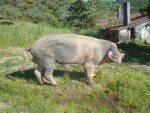 General appearance — Large animals, they reach 1 m in height and 1.5 m from the nape of the neck to the root of the tail;
Coat — White, black or spotted; usually thick skin and the bristles are usually long, thick and abundant;
Head — Thick and with a concave profile; occipital crest directed forward, thick and long proboscis, large mouth. Long, wide and pendulous ears, without covering the eyes. Poorly developed face and reduced jowls;
Neck — Long and regularly muscled;
Trunk — Thorax high, flattened and shallow, with long and slightly arched ribs Long back, convex dorsal-lumbar line. Belly saggy, with ten teats or more. Wide flank and little descent. Croup of good length but narrow, drooping and not very muscular. Medium-set and thick tail; Limbs — Of regular uprightness, long, bony and little muscled. Feet well developed but soft.
Sources:
ANCSUB – Associação Nacional de Criadores de Suínos de Raça Bísara
Agroquisa – Ciências para a Qualidade de Vida
Ruralbit – Fotografias de Raças Autóctones
