




 Português
  English (UK)
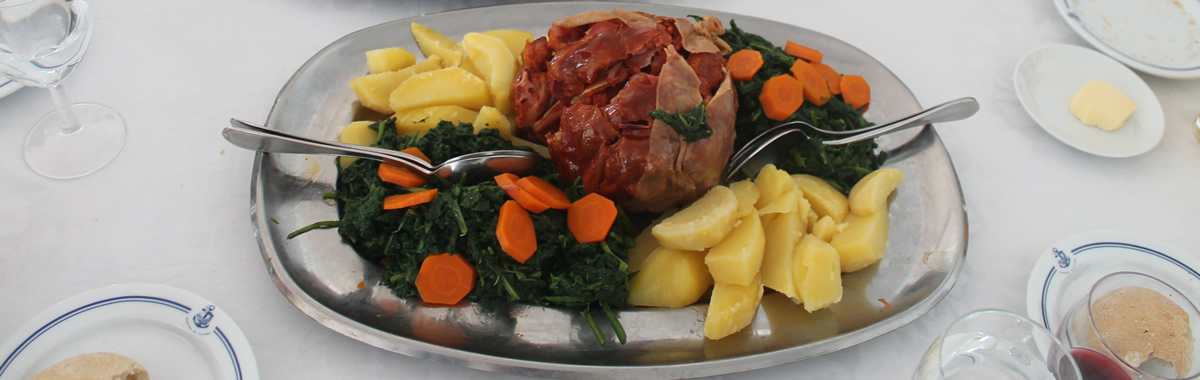
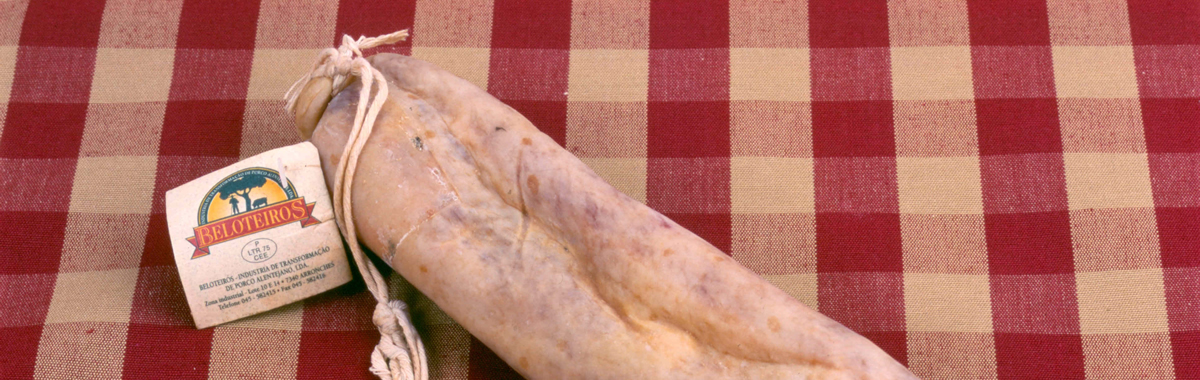
Description: The Guard Buchos weigh between 150 to 250 g, have a diameter of 25 to 35 cm and a length of 20 to 25 cm, when stretched. They have a spherical-elongated shape and a rough appearance. The inner mass is not cohesive, so they break down easily when you try to cut into slices. The casing consists of a pig's bladder or stom-ach, tied at the ends with cotton threads. They have a slightly spicy taste.
Region: Center.
Particularity: Rough, red-orange sausage, consisting of non-cohesive pieces of pork, disintegrating at the cut. It may or may not take bones.
History: This product has roots so far that they can hardly be pinpointed. However, Manuel Leal Freire already refers to this traditional sausage stating that: «... these people appreciate it in an extraor-dinary way... a pig's foot from which the belly came out and which, in addition to being a tasty delicacy, also serves as a cooking index...». The same author also mentions, in relation to the typical Carnival dishes, that: «... The meal is perhaps Tuesday's... The session opens with a tasty broth of pods, made in the cooking water of the bucho, a huge wrapper completely stuffed with pieces of pork — ear, trunk, calubra (neck), esperrilha (vertebral column), ribs and tail, all tanned...». Manuel Joaquim Correia also refers to this sausage in the following terms: «The smoke was escaping through the window... near which was drying a large pig's belly, stuffed with good morsels: tongue, lip, chops, loin and other tasty parts."
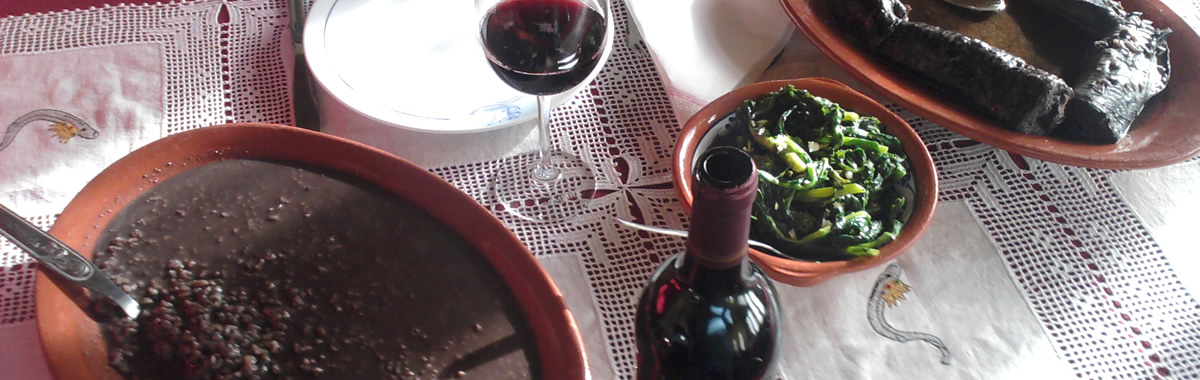
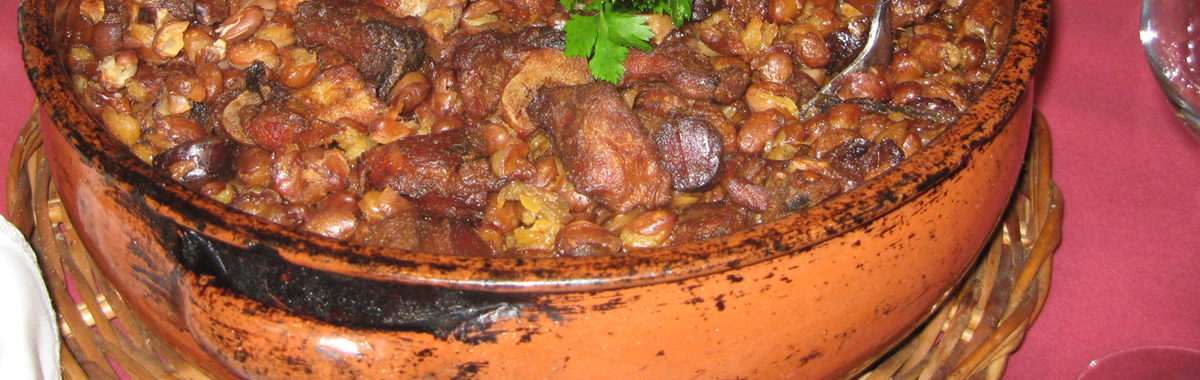
Use: Buchos are eaten cooked inside a linen cloth. They are a typical dish of Fat Sunday (Carnival).
Know-how: Pork, with or without bone, namely head, tail, ribs, cartilage and snout, are cut into medium-sized pieces and seasoned with salt, garlic, paprika, ground chilli, red wine from the region and water. After being about 3 days in this «vinha-d'alhos», they are drained and with them the stomachs and bladders are filled, previously washed. They are tied with a cotton thread and, after closing, are placed in the smokehouse for a week (smoked with oak and chest-nut wood). After smoking, the buchos are stored in dry and cool places to prevent the appearance of molds.
Source: Produtos Tradicionais Portugueses, Lisboa, DGDR, 2001
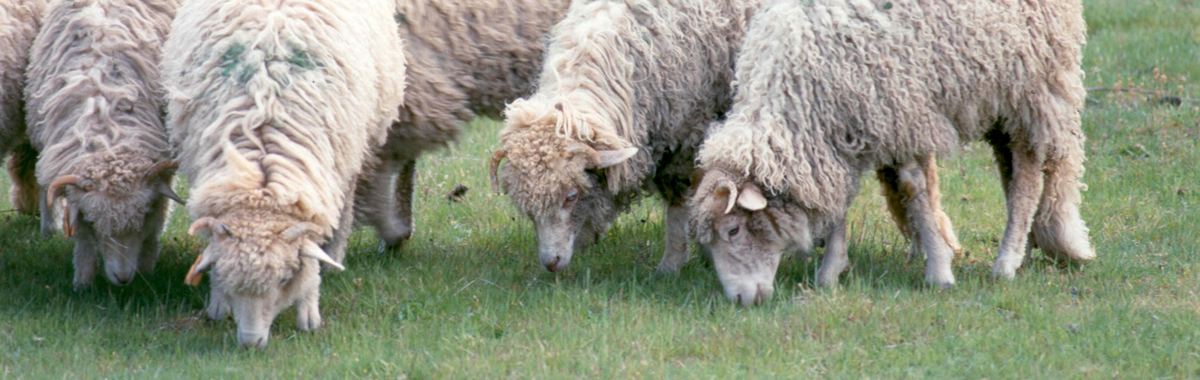
Bísara Pig Breed Standard: As defined in the Studbook Regulation, Bísara Breed pigs are morphologically characterized as follows:
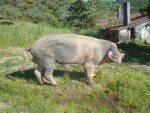 General appearance — Large animals, they reach 1 m in height and 1,5 m from the nape of the neck to the root of the tail;
Coat — White, black or spotted; usually thick skin and the bristles are usually long, thick and abundant;
Head — Thick and with a concave profile; occipital crest directed forward, thick and long proboscis, large mouth. Long, wide and pendulous ears, without covering the eyes. Poorly developed face and reduced jowls;
Neck — Long and regularly muscled;
Trunk — Thorax high, flattened and shallow, with long and slightly arched ribs Long back, convex dorsal-lumbar line. Belly saggy, with ten teats or more. Wide flank and little descent. Croup of good length but narrow, drooping and not very muscular. Medium-set and thick tail; Limbs — Of regular uprightness, long, bony and little muscled. Feet well developed but soft.
Sources:
ANCSUB – Associação Nacional de Criadores de Suínos de Raça Bísara
Agroquisa – Ciências para a Qualidade de Vida
Ruralbit – Fotografias de Raças Autóctones
