



 Português
  English (UK)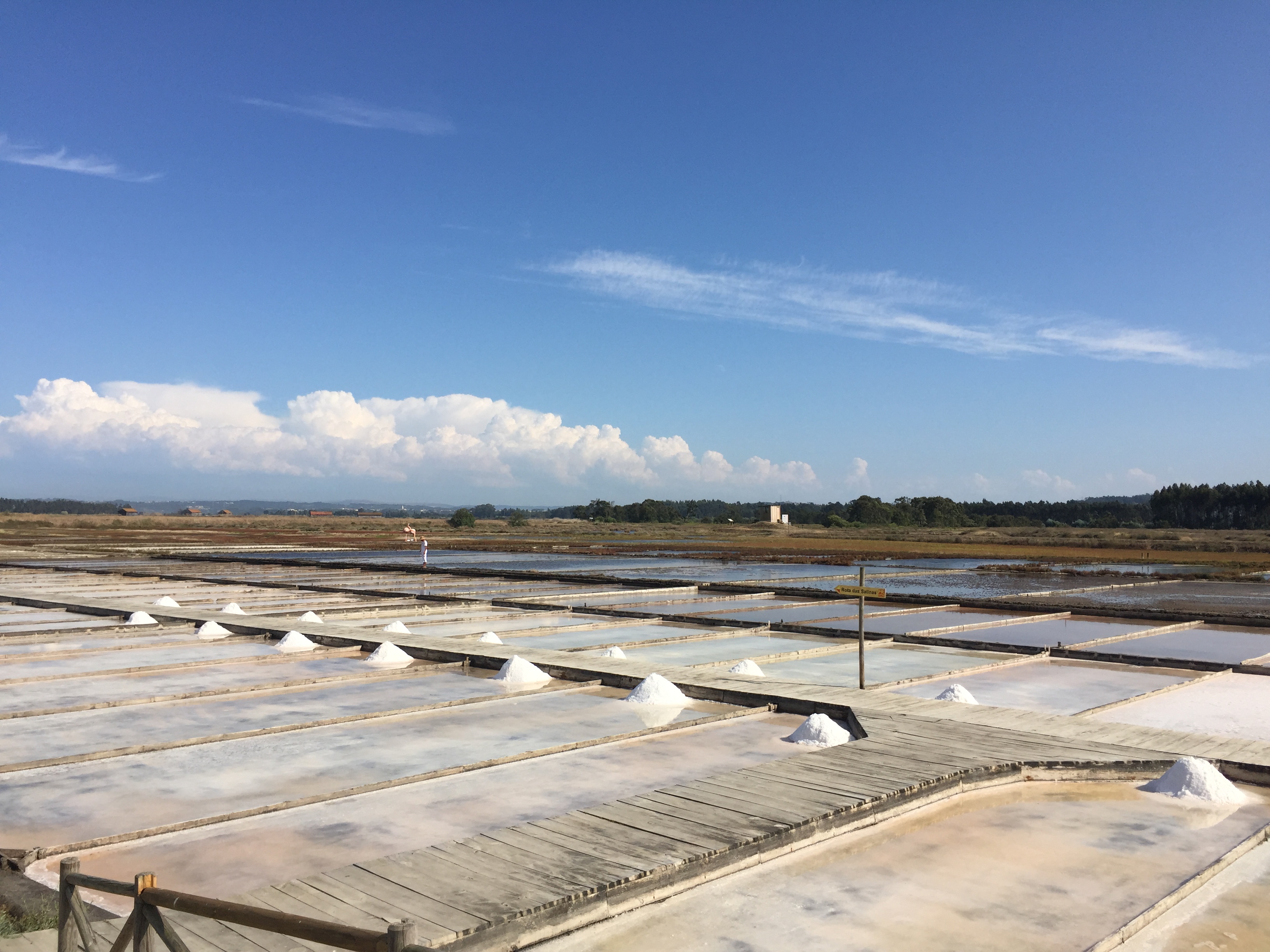
Description: "Salt of Figueira da Foz" and "Fleur de Sel of Figueira da Foz" are sea salt obtained by manual harvesting, from the natural process of precipitation of water from the Atlantic Ocean, consisting of water, sodium chloride and other mineral salts and trace elements, exclusively from seawater. It is an unrefined sea salt, not washed after harvest and without additives. It is presented in the form of "Sal da Figueira da Foz" (cubic salt crystals, colourless and transparent, with a characteristic salty flavour) or in the form of "Flor de Sal da Figueira da Foz" (small crystals, some of which are ar-ranged in straws, fragile and easy to undo with the fingers and that float on the surface of the water of the crystallisers).
Special characteristics: The "Sal da Figueira da Foz" and the "Flor de Sal da Figueira da Foz" have unique characteristics that result from their own artisanal production method, associated with the in-fluence of the surrounding environment, namely, the biodiversity present in the Salgado da Figueira da Foz.
Geographical area: The Salgado da Figueira da Foz is distributed in three parishes: São Pedro, Lavos and Vila Verde, forming three well-demarcated regions: Ilha da Morraceira, Lavos (south bank of the estuary) and Vila Verde (north bank of the estuary).
Region: Center.
Production method: The production of salt consists of the process of evaporation of water under the action of climatic factors (sun and wind) that causes an increase in concentration and subsequent crystallization of salts. The production units of the salt pans of Figueira da Foz are made up of a set of reservoirs built on land and on im-permeable soils, implanted in marsh areas. The typology of the salt pans of Figueira da Foz corresponds to small units with a large number of compartments, connected by a network of canals. Each salt pan has a surprising regularity of layout and an ingenious hydraulic system, which goes so far as to include underground drainage systems, intended to channel the intrusions of fresh water into the area of the crystallizers. The feeding of water from the estuary to the first evaporation reservoirs (ponds and marshes) generally takes advantage of the action of the tides. The flow of water to increase the salt graduation/concentration, through evaporation by the heat of the sun and wind, continues along the following reservoirs (enrebanhos and headwaters) to the crystallizers (beaches), where the sea salt is deposited. The movement of the waters, led by the marnoto, the person who manufactures the salt and more particularly, who directs the work of the navy, uses the gravitational potential of the first reservoirs, whose topographic elevations are higher than those of the others. The orientation of each salt pan and the prevailing winds influence the entire evaporation/crystallization process.
Know-how: Over the centuries, the exploitation of salt pans has been carried out using traditional techniques and instruments in the production process. Marnoto simultaneously controls the water level and its circulation in the various ponds, to allow the progressive concentration of salt over the weeks (maintenance of a concentration in the butchers very close to crystallisation), the natural purification of the water by decantation and, finally, the harvesting of the product. The "Fleur de Sel of Figueira da Foz" is made up of the salt crystals that form on the surface of the water during the production of salt. It is harvested manually by extracting the rennet suspension that forms in the butchers, with the help of a specific instrument, before falling to the bottom of the ponds.
Forms of marketing: Both "Sal da Figueira da Foz" and "Flor de Sal da Figueira da Foz" can be flavored with mixtures of spices and/or aromatic herbs, and then packaged in containers intended for sale to the final consumer.
Product availability throughout the year: Although it is only mined in late summer/early fall, this product is stored and marketed year round.
Product history: The first known references to the exploitation of salt in the Mondego date from the beginning of the eleventh century, and refer to salt pans in Tavarede (north side of the estuary) in 1096 (Vir-gínia Rau, "Studies on the history of Portuguese salt"). In the twelfth and thirteenth centuries there are several references to salt pans in the Couto de Lavos. The practice of salt production in the region of Figueira da Foz - in Lavos and Morraceira - dates back to very ancient times, at least to the medieval period, having persisted in time, until the present moment.
Representativeness in local food: The production of salt has a relevant expression in the local economy of Figueira da Foz and tends to increase its representativeness in the regional economic fabric, due to the association of this artisanal product with a wide variety of products made with this raw material. Currently, there are already several salt producers selling value-added products, based on salt, fleur de sel and halophyte plants from Salgado da Figueira da Foz.
Source: DGADR, based on: MAREFOZ – MARE-UC (2017), Avaliação Integrada, Ecológica e Sociocultural do salgado da Figueira da Foz na perspetiva do Desenvolvimento Sustentável; Quitério, Natália Fidalgo (2016), Territórios, recursos naturais e salinas. As técnicas tradicionais de produção de sal. O caso da Salina Municipal do Corredor da Cobra (Núcleo Museológico do Sal), Figueira da Foz, Faculdade de Letras - Universidade de Coimbra.
Photo: DGADR
