







 Português
  English (UK)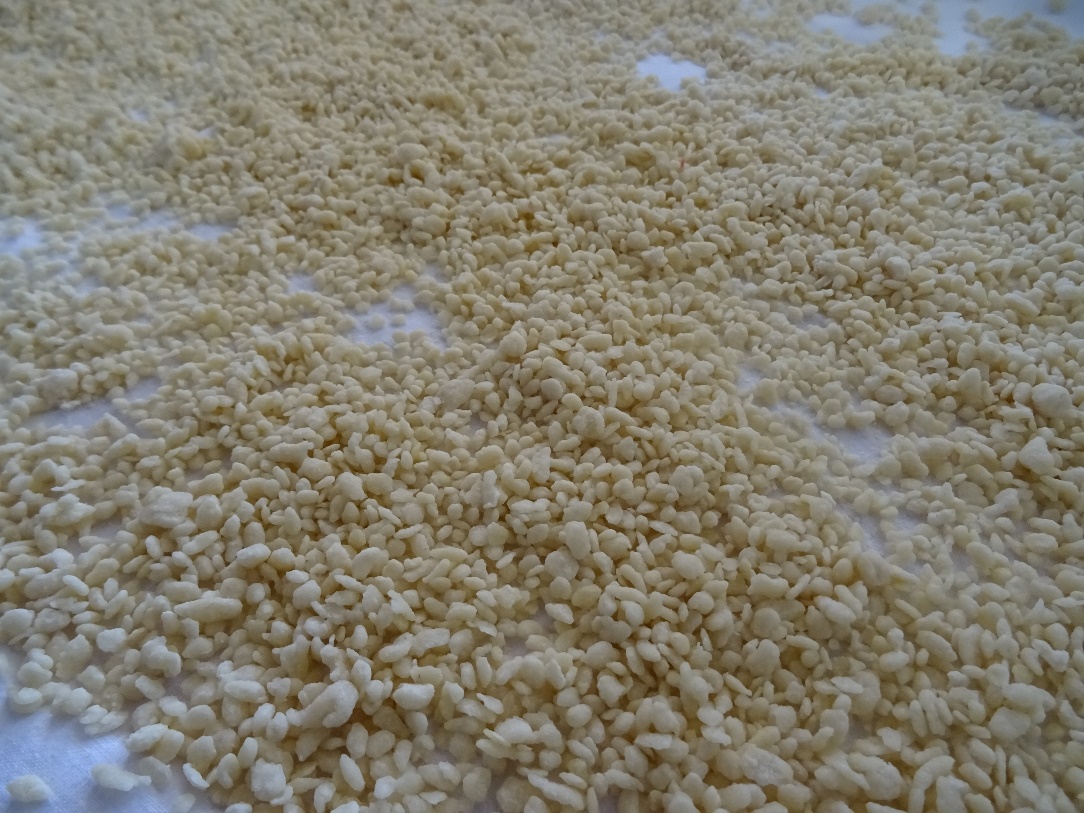
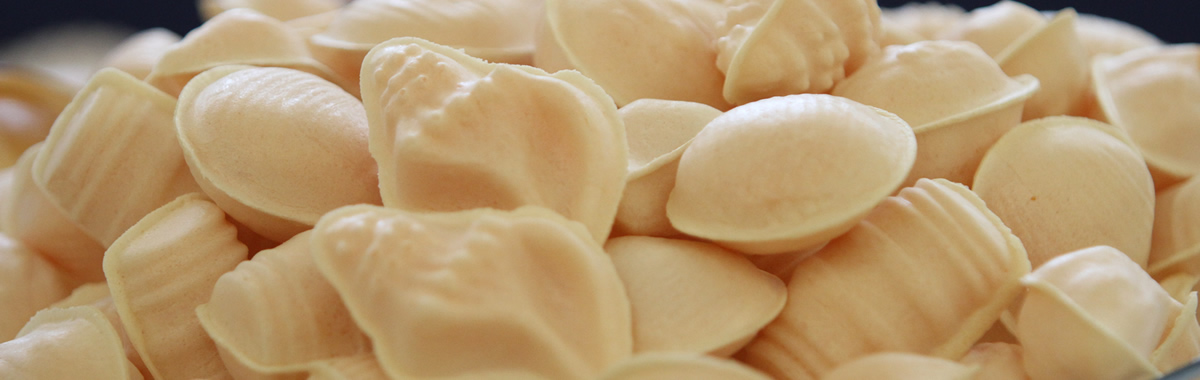
Description: Cuscos are clumped grains of flour, steamed with the help of a specific container (the couscous pan), and dried in the air or sun, so that they can be preserved for several months. With some punctuality during the year, usually in spring or autumn, only a few women from some localities of Vinhais and Bragança still make cuscos. To do this, they resort to wooden dough pans where they place the flour.
Special characteristics: Rich in carbohydrates and with a flavor similar to that of Italian pasta and with a texture close to that of rice, with great versatility it can be served as an accompaniment to a wide range of meat or fish dishes, in soups and even in sweets.
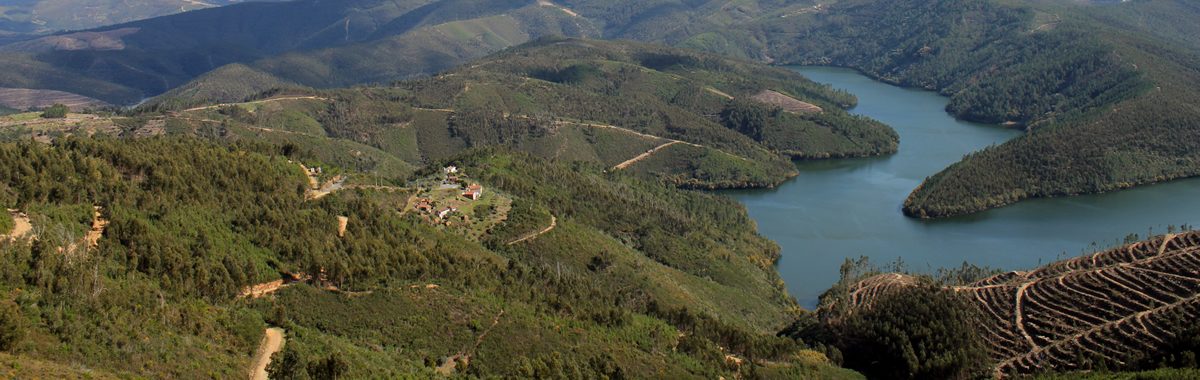
Region: Trás-os-Montes (to the present day in the municipalities of Bragança and Vinhais).
Ingredients Used: Wheat flour, water and salt. In addition, eggs and herbs can be used.
Know-how: To make cuscos, wooden dough pans are used, conventionally used to make bread, and where the flour that is intended to be transformed into cusco is poured.
The flour is then sprinkled or sprinkled with warm, salty water, with the aid of a broom or by shaking your fingers. It is these splashes of water that will help form the grains of cusco. With the palm of the hands, stepping or "caressing" the flour, in circular movements, which must always "go" in the same direction, the balls are formed, an action that is called "twisting" the cusco. The cooks of cuscos say that it is important to always "twist" the same way so as not to "untwist" or "not to undo what has been done".
This stage of "twisting" the cusco is quite long and physically demanding. Therefore, as a general rule, the help and company of other people is privileged, to help with work and pass the time. The time it takes for the task to take depends on the amount of flour you use and the amount of cusco you want to obtain.
One of the particular characteristics of the confection of cuscos in an artisanal way is the obtaining of grains of varying caliber. To obtain a more uniform variation, the couscous grains are sifted with the help of a sieve. The optimally sized beans are reserved, the smaller beans return to the dough pan to be sprinkled with water and twisted again, and the larger beans are crumbled by hand.
As the grains are formed, the "roar" of the action of crushing the grain against the wood of the dough tree changes. The noise of the grains rubbing, rolling between the hands and the wood of the dough pan intensifies until the end, determined by the taste of each cook and the technique of squeezing the cuscos, according to which when squeezing two hands full of grains they come off easily, the cusco is ready.
Then let it rest and dry (between one to two hours). After the break, a three-legged pot of water is placed on the fireplace. Inside the couscous pot - a proper clay container, or tin can as an alternative - a cloth (usually linen) is placed and the couscous pot is filled with cusco. After they are well packaged and wrapped and covered by the linen cloth, the couscous pan is placed under the pot of boiling water. The intersection between the couscous pan and the pot is sealed with a mass of water and flour, so as not to let the steam escape from the pot. About an hour to an hour and a half later, the cusco is ready. This cluster of grains of flour that are again arranged in the dough pan is called "carola", which can be consumed while still hot, with honey or sugar or even plain.
The "carola" is then again broken into grains that are once again twisted in the dough bowl. After separating, the cusco beans are left to dry in the sun or in a ventilated place in the house, under a table or a towel. After at least two days, the couscous can be bagged and preserved in cloth bags, to be consumed throughout the year, as a substitute for rice or pasta or even in "cusco soup" with milk (served as a starter and not as a dessert since it is not a sweet dish).
Forms of commercialization: As it is a seasonal product, it can be found for sale in bulk at local fairs and markets.
Product availability throughout the year: Increased availability in the autumn and winter months.
Product history: Originating in North Africa, the appearance of kuskus (from Berber or Arabic pronounced ku:sku:s) in the diet of the populations of that territory is difficult to specify. It is the archaeological finds of objects made of clay and similar to the "couscous pots" that are still used today in their firing and also of the lunchboxes where they would be placed, that take us back to their preparation and consumption in the ninth century, in that region (Vasconcelos, 2014).
It is with the Islamic conquests that the kuskus expands through the countries of Sub-Saharan Africa and the Mediterranean, reaching the Iberian Peninsula (or Al-Andaluz, the name given by the Islamic conquerors to this peninsular territory).
This evolution or transformation of eating practices is accompanied by the evolution of cereal cultivation, in particular the development of the cultivation of durum wheat (Triticum durum), which finds favourable climatic conditions in the Iberian Peninsula.
In "Alimentos e Alimentação no Portugal Quinhentista" (2002), Isabel Fernandes characterizes the dissemination of varied wheat-based recipes throughout the country and the common consumption of couscous at the time, quoting João Brandão who in 1552 described its consumption in Lisbon as follows: "And I say that in this city there are fifty women, between white and black, forras and captives, who at dawn go out in Ribeira with large pots full of rice, and couscous and chícharos, proclaiming." (Brandão, in Fernandes, 2002:136).
Couscous would then become part of the menu of the Portuguese courts «In November 1524, at the table of King João III, couscous went "to couscous of the King of cow five arráteis".» (Santos, in Fernandes 2002:136). In Jantar e cear na corte de D. João III, Maria José Azevedo Santos observes that «meat occupied, in the diet of sixteenth-century high society, the first place» and that «it arrived at the King's table, cooked, in pastel or for couscous, ways of cooking it common in this time of the 1500s» (Santos, in Fernandes 2002:145).
Attesting to its widespread consumption among "nobles and poor" in sixteenth-century Portugal, it is to King D. João III, in 1525, that Gil Vicente presented the theatrical work O Juiz da Beira, making the Squire complain about the crusader that the character, Ana Dias, had spent on couscous.
The regiment and fee of potters from Coimbra, dated 1573, also refers to the manufacture of couscous (a container suitable for steam-ing couscous) in glazed crockery. But «over the years, new eating habits distanced the Portuguese from the consumption of couscous, and therefore the potters stopped producing the container where they were cooked - the couscous» explains Isabel Fernandes: «if there is no one to look for the container, there is no longer anyone to produce it - the need for the vessel is extinguished, its production is extinguished» (2003: 23).
The grandson of King Dom João III, D. Sebastião even legislated against the "excessive" consumption of couscous. It is thus, through the documents of the Holy Office of the Inquisition (century. XVI), which understands the relationship between the practices of Muslim converts to Christianity, then called Moriscos, and their food prac-tices, which led to the "persecution" of their consumption.
Thus, in addition to being a food that could be preserved for a long period and a great substitute for rice, and pasta and therefore much appreciated by the general population from the rural fields to the Por-tuguese courts, the consumption of couscous is also associated with festive and funeral ceremonies practiced by Muslims and Jews of the Maghreb, and that in sixteenth-century Portugal continue to be practiced by the Moors. Barros and Tavim (2013), analysing the inquisitorial processes on Muslim religious ceremonies, refer for ex-ample to the "gifting of the dead".
Mouette Barboff (2010) says about the consumption of wheat in Portugal that the practice of making couscous by hand is still found in the northeast of Trás-os-Montes, on the island of Santa Maria in the Azores archipelago and on the island of Madeira.
According to Barboff, in Trás-os-Montes there are variants regarding the element that serves as the basis for the confection of couscous grains. Quoting the author from Trás-os-Montes, Afonso Belarmino (1982), the Trás-os-Montes couscous (which takes on the common designation of "cuscos") can be prepared with soft wheat flour (triga flour) or durum wheat semolina, particularly appreciated for its quality. According to the references of Belarmino Afonso (in Barboff, 2010: 49-50) in the region of Bragança and Vinhais, cuscos are prepared once a year, for the whole year, in autumn. Also according to the author, wheat was milled in mills with "alveiras" millstones (made of limestone and more suitable for grinding wheat). Then the flour would be sprinkled with warm salt water with the help of a willow branch. Used to thicken soups, cuscos, says Belarmino Afonso, were used to replace rice and pasta, meeting the food needs of the more modest populations.
Alfredo Saramago (1999) describes the confection of couscous in the work he dedicates to the cuisine of Trás-os-Montes, referring to the way they are prepared in the region of Vinhais. Without specifying the variety of wheat used, he points out that it is a "badly milled" flour. The process, of confection in almost everything similar to the process described by Afonso Belarmino, diverges in a small curiosity. Instead of the willow branch, Saramago refers to the use of a pi-assava broom (a kind of palm tree of Brazilian origin with fibrous leaves).
AFONSO, Belarmino (1982), O Cozer do Pão.
BARBOFF, Mouette (2010), Couscous de blé et semoule de mais au Portugal, in Hélène Franconie, Monique Chastanet et François Sigaut (orgs.), Couscous, boulgour et polenta: transformer et consommer les céréales dans le monde. Paris: Kharthala Editions, 47-54.
BARROS, Maria Filomena Lopes de e TAVIM, José Alberto Rodrigues da Silva (2013), "Cristãos(ãs)-Novos(as), Mouriscos(as), Judeus e Mouros. Diálogos em trânsito no Portugal Moderno (séculos XVI-XVII)". Journal of Sefardic Studies, 1 (2013), pp. 1-45.
FERNANDES, Isabel (2002), Alimentos e Alimentação no Portugal Quinhentista. Revista de Guimarães, nº 112, pp. 125-215.
FERNANDES, Isabel (2003), De barro se faz memória, in Raquel Henriques da Silva, Isabel Maria Fernandes, Rodrigo Banha da Silva, Olaria Portuguesa: do fazer ao usar. Lisboa: Assírio & Alvim, 17-33.
MARCELINO, Adozinda MARTINS, Acúrcio, (2015), Memórias Da Cozinha Transmontana. Âncora Editora.
MODESTO, Maria de Lurdes (2014), Sabores com Histórias. Oficina do Livro.
MONTEIRO, António (2014), Comidas Conversadas. Âncora Editora.
SARAMAGO, Alfredo (1999) Cozinha Transmontana. Assírio & Alvim.
VASCONCELOS, Isabel (2014), À volta do cuscuz. O Gorgulho - Boletim Informativo sobre Biodiversidade Agrícola, Ano 11 - Nº 32, Inverno 2014, pp.23-26.
