




 Português
  English (UK)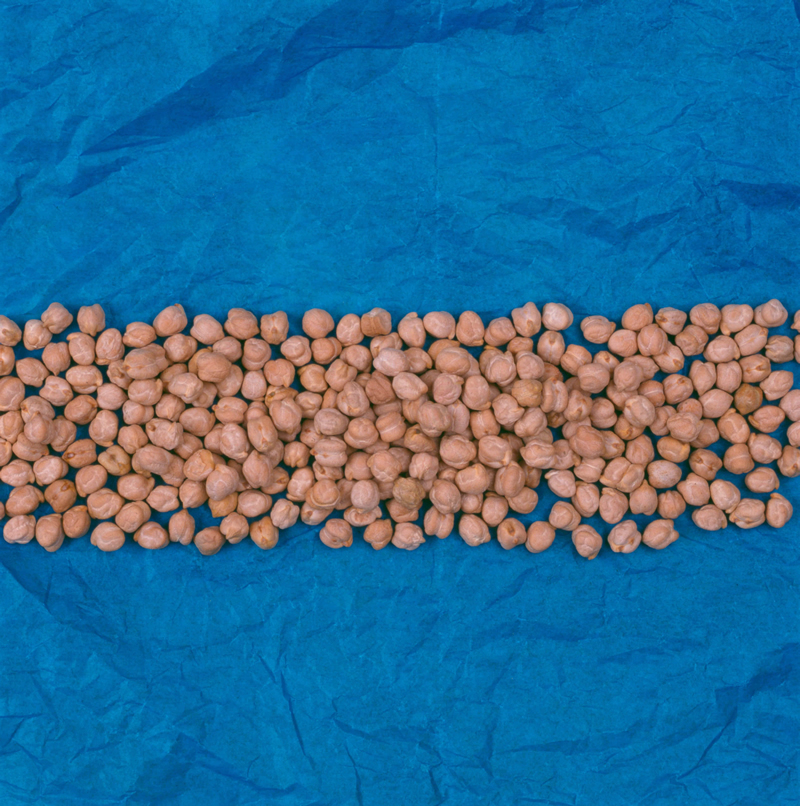
Description: Chickpeas are the seed of a legume of the genus Cicero arietinum L., with a size of about 1 cm and yellowish color.
Region: Alentejo.
Other denominations: Grain. Grprogresso.
Particularity: Dried legume, yellowish grain and boll weevil.
History: Chickpeas are a legume widely consumed throughout the country. Its origin seems to be the Middle East (Anatolian plateau), from where it came to Europe with the migrations of peoples and their commercial exchanges. The date of its introduction in the Iberian Peninsula is not known, but both its Spanish and Portuguese names point to its existence predating the Romans, and is most likely due to the Arabs.
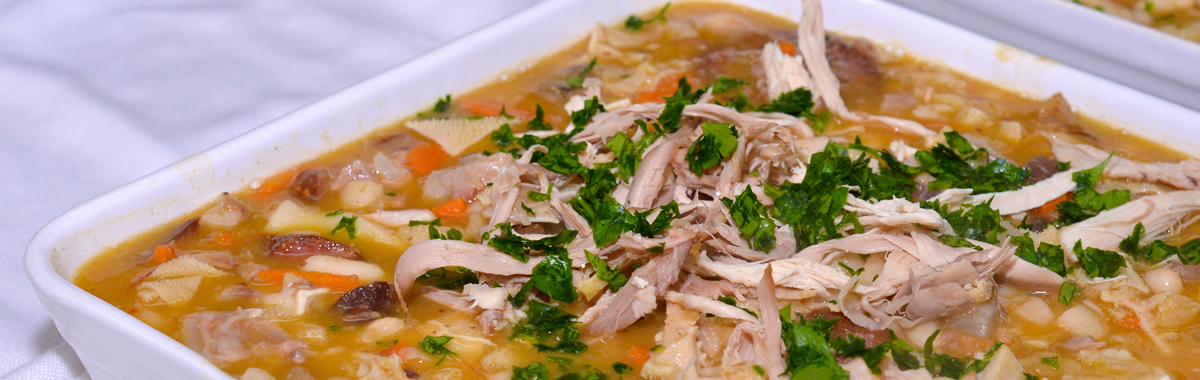
Use: The importance of chickpeas in the Portuguese diet is so marked that it is consumed from north to south of the country, in dishes as different as soups, stews — with pork or with cow's hand, stew — accompanying boiled cod and «meia desfeita» (popular cod dish) or as an ingredient for the filling of desserts — azevias de Peniche, for example. Very curious is its use to make homemade appetizers (fried and salted), replacing more expensive nuts. As a curiosity, the following popular saying is quoted: «The grain only needs two waters: that of sowing and that of baking.»
Know-how: The culture of chickpeas is on its own. It is usually used as an integrated crop in the rotation of cereals. In the Alentejo, this crop assumes, in certain regions (the so-called Barros Fortes), great economic importance, because it makes it possible to make the most of the soil mobilizations identified by bushel (a cultural operation carried out in the year prior to the sowing of wheat, in which the soil is ploughed three times to allow a good mineralization of the land and covered with the cultivation of chickpeas). The seed is usually prepared by winnowing it by sieving it with a sieve of 8 to 10 mm and refining for seed only the most gractive. In addition, those that are smoother and without deformations are also chosen. Sowing is done in March. Very little fertilization was done on the grain land. Sowing can be done by haul or in rows. In the haul, the earth is grated and entangled in 5 m hands. Today very few farmers sow the grain by hauling, sowing in separate rows of 70 to 80 cm. The harvest usually begins in mid-August, leaving the grain in buckets until it is completely dry, and then carried to the threshing floor where it is threshed. Here, the chaffing processes still today range from manual beating to the use of pack animals (oxen) for this purpose, or to the use of the mechanical threshing machine in the most modern cases. The grain is then cleaned, screened and chosen. Chickpeas are usually harvested by women, during the early hours of the morning, while there is humidity. The reason is that since the straws were very fragile, if the grain was picked up in the terrible heats of August, the stalks would break, and many pods would be lost. This process gives rise to great revelries and popular songs so much to the taste of the Alentejo people, who always manage to take advantage of the most adverse situ-ations.
Source: Produtos Tradicionais Portugueses, Lisboa, DGDR, 2001
