


 Português
  English (UK)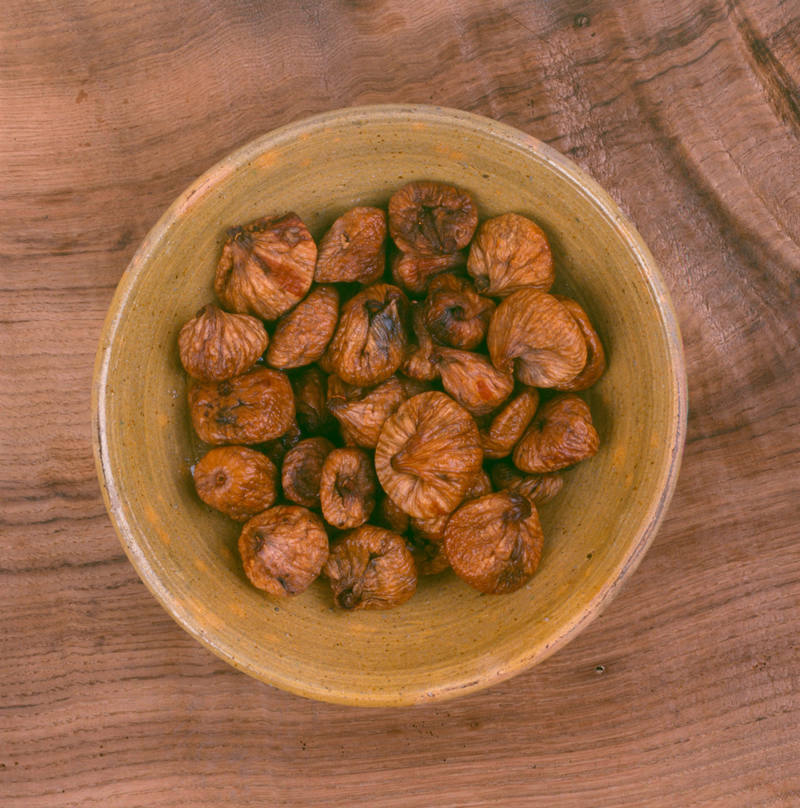
Description: Fresh fig — A pyriform, globose, flattened or conical sicon, yellowish or violet in color. The lampos are 40 to 45 mm long by 40 to 60 in diameter and weigh 60 g to 110 g and the vindimos are 30 to 35 mm long by 30 to 45 mm in diameter and weigh 50 to 80 g.
Dried fig — Sun-dried figs with thin skin, honeyed consistency and unit weight between 10 and 15 g.
Region: Algarve.
Variantes: Fresh Figo and Passa de figo.
Special feature: Fresh figs generally have two production seasons (2 layers): one in May/June (lampos figs) and another from the end of July to December (harvested figs). The dried fig is flattened, pearl-white to yellowish in color.
History: The fig tree is originally from Afghanistan and from there it has spread throughout the Mediterranean basin. In Portugal, culture was focused on the Algarve coast and in the Torres Novas area. In 1577, Friar João de S. José wrote that "... it is good food, especially for those in the Algarve, who are already used to it». Silva Lopes, in 1841, also mentions that figs from the Algarve are very tasty and nutritious and that in 1708 4,500 to 6,000 tons were already exported to the ports of the Kingdom and to those of Holland, Belgium, France and England and 10,500 to 12,000 tons were dried in the sun. Romero Magalhães mentions that, in 1605, a Frenchman named La Corsa had to commit to importing 16 mills of rye in order to export 800 pieces of figs. Due to its great nutritional value, concentration and good conservation capacity, it was of great interest to «satisfy the hunger of many people in periods of crisis». During the world wars it was exported in large quantities to Germany and North America.
Use: The fig is part of the traditional diet of the populations of the Algarve. Fresh is consumed as a starter or as a dessert or as a raw material for jams and sweets. Dry, it is used just as it is or as part of the rich Algarve sweets.
Know-how: The fig tree in the Algarve is part of the traditional orchard consisting of scattered or intercropped trees (carob, almond and olive). For fresh figs, the best and freshest soils are used, because they produce fruits of greater caliber. The trees are pruned carefully and, in order to obtain better fruit, a collar is placed on the varieties that need caprification (this process, also known as "burrowing the fig trees", consists of hanging a fig fig on the fig tree, where a pollinating insect develops to promote fertilization). For fresh consumption, the fig is harvested in the morning and packed in cane baskets lined with fig or vine leaves. For drying, light figs are harvested from mid-August to the end of September, very ripe (with the foot twisted). They are placed in a sheltered place exposed to the sun's toast on cane mats, which are rolled up during the night to pro-tect them from moisture. Early in the morning, those that have reached the ideal state of drying are removed. Before packaging, the fig is washed, dried and pressed.
Source: Produtos Tradicionais Portugueses, Lisboa, DGDR, 2001
