

 Português
  English (UK)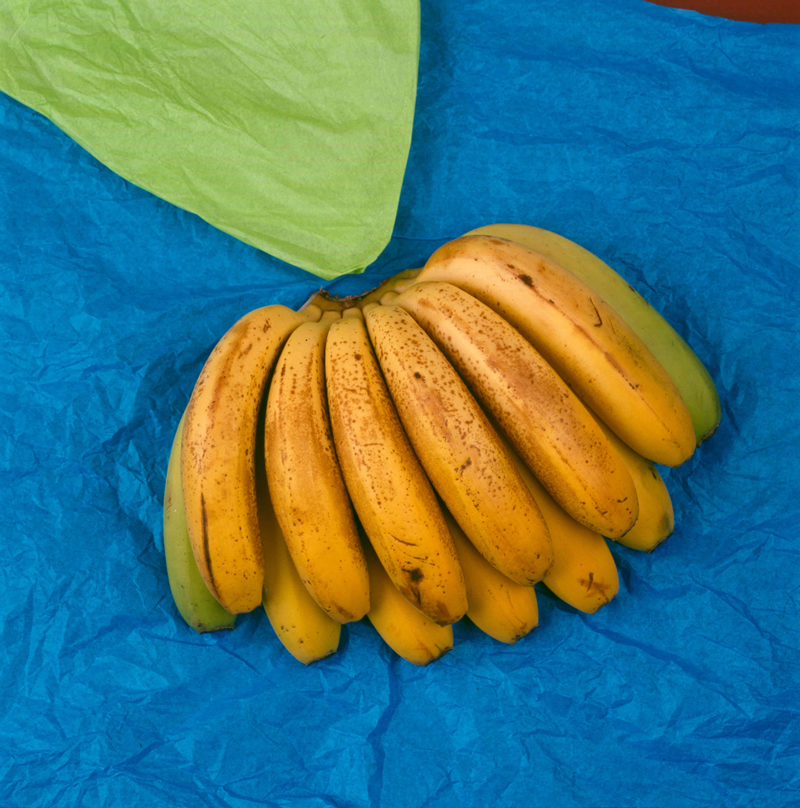
Description: Herbaceous, perennial, acaule plants (false trunk made up of leaf sheaths), belonging to the species Musa cavendishii, with leaves that are often very large and between 1.30 and 1.70 m high. After originating leaves, the plants emit a floral escapement, in which the first groups of flowers originate the edible fruit. The fruits, arranged in clusters, are elongated berries, with an average length of 14 cm.
Region: Autonomous Region of Madeira.
Particularity: Fruit of yellow color, relatively short length and pleas-ant and characteristic flavor, very sweet.
History: Eduardo Pereira (1939) states that the introduction of the banana tree must date back to the middle of the sixteenth century. As early as 1552, Nichols, an English traveller who was in Madeira, refers to the existence of this culture (probably the banana tree of the land Musa sapientum L.). Menezes (1910) considers that it was in the seventeenth century that culture began to have a certain increase. Silva (1946) refers to the introduction of the "Anã" banana tree - Musa acumínata Cola AAA - in 1842, originally from Demerara. A similar reference is made by Pereira, to the Zargo Islands, but indicating China as its origin. In 1911, 550 tons were exported. It is one of the main riches of Madeira. Its natural qualities give it an almost universal fame.
Use: It is consumed just as it is, at any time of the day, and is highly appreciated as a dessert, accompanying a slice of sheep's cheese. It is essential for the manufacture of banana liqueur and is part of some dishes of the local cuisine. Given their sweetness and ease of swallowing, they are usually much appreciated by children, and the snack prepared with Madeira banana, biscuits and orange juice is traditional.
Know-how: Crop very demanding in heat and humidity, and its activ-ity is strongly reduced at temperatures below 16 °C. This is the reason why Madeira's banana plantations are located on the warmer coast, facing south, up to 200 to 250 m altitude. The steep slopes of the island forced the land to be set up in «terraces» or «poios». The banana tree is very demanding in water, so it must be installed on irrigable land, requiring irrigation in the summer, which implied the construction of extensive irrigation channels - the so-called «leva-das» (because they carry the water). Traditional fertilizations are carried out 2 to 3 times a year, and an annual pit is also made to bury the manure. Throughout the year, cleaning is carried out (cutting of dry leaves), staking (support of plants with bunches by means of cuttings that allow them to resist weight and wind) and selection of the shoot (annually the plant - son - that will go into production is selected, and the rest are cut). The harvest of the bunches is done throughout the year, with the main focus on the summer months. The 'bunches' are harvested at the appropriate stage of ripeness so that the fruit arrives at the places of consumption in good condition. Before transport, the 'bunches' are cut into 'bunches' and packed in cardboard boxes. New plantings are carried out between April and June, and it is normal to be able to make the first harvest 16 to 19 months after planting.
Source: Produtos Tradicionais Portugueses, Lisboa, DGDR, 2001
