








 Português
  English (UK)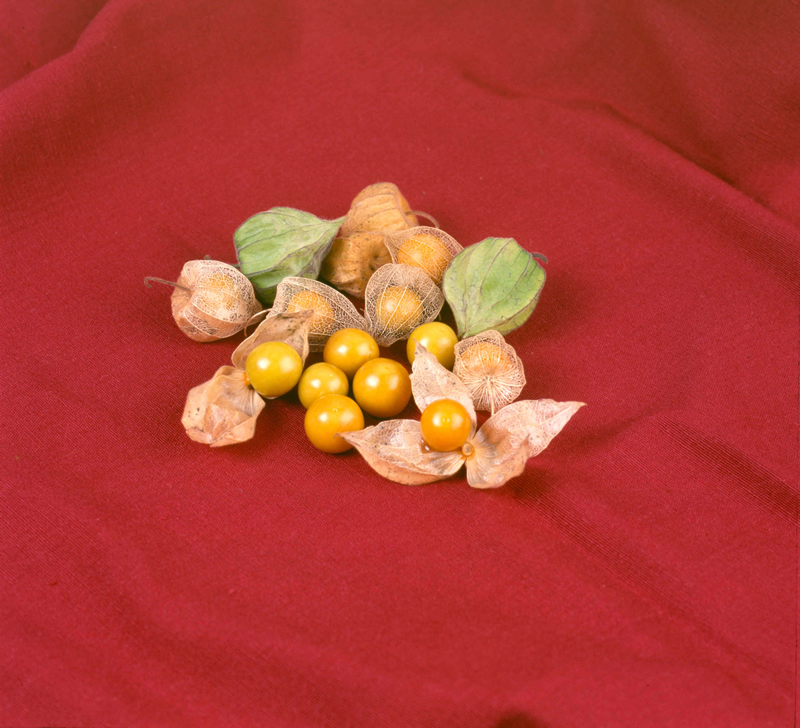
Description: Fruit of the variety Physalis peruviana L. (Cape Goosberry), rich in vitamins A, B, C (60 mg/100 g), with high levels of phosphorus and iron. It is a berry with a diameter of 1.5 to 3.5 cm, with several flattened seeds, resembling a miniature tomato. The fruit is ripe when the casing or 'hood' is brown and the fruit is orange. It has a peculiar flavor that corresponds to a mixture of the flavors of strawberry, kiwi and blackcurrant, and the appearance of a tiny to-mato when free of its brownish wrapper.
Region: Autonomous Region of the Azores.
Other names: Capucho Tomato or 'Candy'.
Special feature: Berry that looks like a small tomato, set in a brownish wrapper (capucho).
History: The Capucho is originally from the Andes, specifically Peru. In Portugal it is known as Capucho or Tomate Capucho and in the Azores it is known as «Rebuçado». In 1867, Edmond Goose, garden-er of the Botanical Garden of the University of Coimbra, during a trip to the Azores describes several plants, including the Capucho. It is a sub-spontaneous plant in the Azores, appearing in vineyards and orchards.
Use: The fruit is consumed fresh or in jam, known as capucho jam, and there is even a small production of canned jam that began to be manufactured by the Sociedade Corretora Micaelense, founded in the early twentieth century by Cristiano Pacheco.
Know-how: There are outdoor Capucho plantations. The plant is annual (if pruned, it can produce for 2 years) and indeterminate (it can flower in any season). From sowing to the first production it takes about seven months. Sowing should be done in March/April, plant-ing in May/June and harvesting in summer/autumn.
Source: Produtos Tradicionais Portugueses, Lisboa, DGDR, 2001
