



















 Português
  English (UK)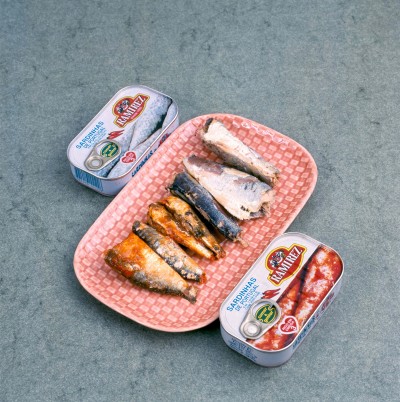
Description: Canned sardines consist of sardines with skin and bone, headless, gutted, without a tail fin, trimmed or not, arranged in reverse symmetry and covered with olive oil or another sauce. The boneless or skinless and boneless preserves are identical to the previous one, and the sardine is presented according to the description. Sardine toutiços are made up of the whole anterior portions, of a length of not less than 3 cm, resulting from the trimming of large sardines.
Special features: Sardines exclusively of the species Sardina pilchardus (Walbaum), of the family Clupeidae, preserved by sterilisation and covered with olive oil or other covering liquids, packed in tinplate or aluminium cans, weighing 125 g.
Delimitation of the geographical area of production: Algarve and Lisbon and Vale do Tejo ‒ Coastline, Center ‒ Coast and North ‒ Coastline.
Variants: Canned sardines without bone or without skin and without bone. Sardine towels. Sardine roe. They are presented in olive oil, water, vegetable oil, tomato sauce and others.
History: Canned fish is mainly due to the technological innovations of the early twentieth century. It was Appert who initiated the sterilization process and Peter Durand who invented the first metal box. In Portugal, the first factory of fish preserved by sterilization was located in Setúbal, in 1880. There is news that a canned sardine in Portuguese olive oil was exhibited in Paris in 1885. Canning reaches its peak in the Algarve in the 30s. The importance of the different canned fish in the country's economy and in the diet of the Portuguese is so important that there are specific Technical Rules (Portuguese Standards) for each product, enshrining the genuineness of each preserve, the species of fish that can be used and the respective form of presentation.
Use: It can be eaten as it is, at meals, with boiled potatoes and onions, or accompanying various salads, passing through more or less compound appetizers and ending up in much more elaborate dishes (rissoles, pies, stuffed pies, etc.). Its consumption is rooted in the Portuguese population.
Know-how: In the Algarve, sardine fishing is of special importance in Portimão and Olhão. Fishing is done through fencing gear with bow nets transported in trawlers with a capacity of between 300 and 500 kg. The best period for catching is between June and December, when the sardine has its best qualities for fresh consumption. In Portimão, the festival of «grilled sardines» takes place in June. For the preserve, the sardines, very fresh, are headed, gutted and washed. It is then packed in the packaging and soaked in the various sauces. The boxes are hermetically sealed by crimping and sterilized in an autoclave. At the exit of the autoclave, the packages are washed, dried and properly labeled. It is common to present it in pyrographed cans or wrapped in cellophane or cardboard.
Product Availability: All year round.
Source: Produtos Tradicionais Portugueses, Lisboa, DGDR, 2001
