

 Português
  English (UK)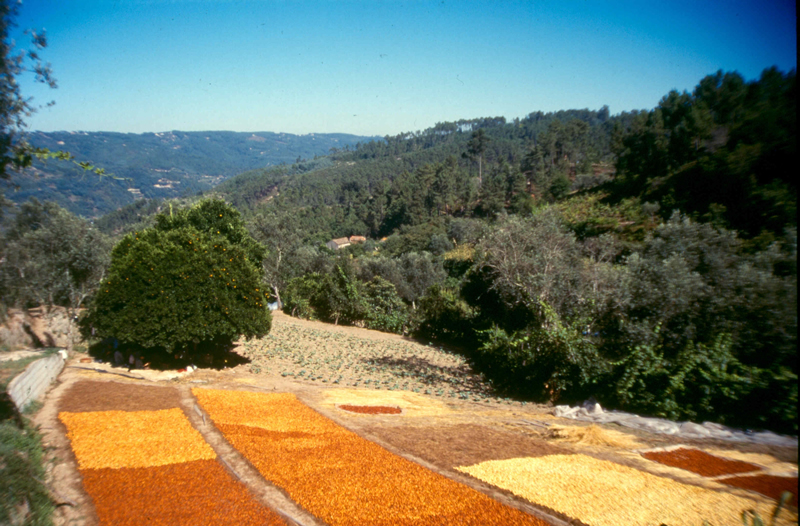
Description: The dried fruit is prepared from pears of the S. Bartolomeu pear tree, the result of a long work carried out by man. The fruit is small, greenish in color with lenticles, rounded and ovate, with a long and curved peduncle, appearing in groups of 5. The dried fruit has an average diameter of 30,2 mm, a height of 15,5 mm and a weight of 8,7 g, and its color is reddish-brown.
Region: Center.
Other appellations: Pêra Passa. It passes from Viseu. Presuntinhos de Viseu.
Special feature: Dried pear, peeled, of tiny proportions, sweet and tasty, which appears on the market at Christmas time.
History: The designation of S. Bartolomeu pear tree indicates the time of ripening of the fruit: St. Bartholomew's Day, on August 24th. The raisin contains in itself a sum of flavors that have been fine-tuned from generation to generation, guaranteeing it as a genuine traditional resource of this inland area of the country. It used to be sold in the second half of September, during the Feira Franca de Viseu.
Use: Usually consumed at Christmas time, where it takes on a special value due to its rarity and sum of flavors.
Know-how: The pears used in drying come exclusively from the S. Bartolomeu pear tree. The harvest takes place in the last three weeks of August. The operator shakes the branches of the pear tree to force the pears to fall. With their hand or with a hook, the pears are picked by women, working in pairs. They are then peeled with a knife or razor and placed on the raisins. The walkways are wooden containers that have, at the bottom, a pine needle bed about 10 cm high. After 5 days in the passeira, the pears are «embarreled» in baskets that are muffled with a blanket. This operation is done at the hottest time of the day, with the pear being "bured" for 1 or 2 days, in the shade. The pears are then flattened with the espalmadeira, which is an instrument formed by two pieces of wood articulated by a piece of leather. The flattened fruits are placed in the sun on white sheets spread on threshing floors, for 2 or 3 days, to finish drying.
Source: Produtos Tradicionais Portugueses, Lisboa, DGDR, 2001
