




 Português
  English (UK)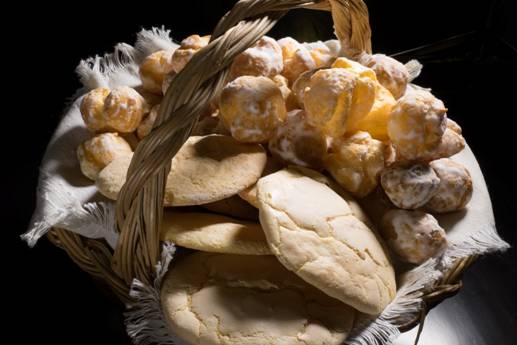
Description: "Fair confectionery" refers to dry cakes, similar to biscuits, made from wheat flour, sugar and eggs and whose weight and size may vary according to the specialty. Among the most recognized and distinctive sweets, the Caladinhos, the Bolinhos de Gema, the Belindres (or Melindres), the Raivas (de Fataunços), the Cavacas, the Passarinhas and the Beijinhos stand out.
Special characteristics: This type of confectionery is always based on a simple recipe, with basic and accessible ingredients, and the secret of the success of the recipes is the temperature and mainte-nance of the temperature of the wood oven.
Region: Municipality of Vouzela and other nearby localities.
Ingredients used: Wheat flour, eggs, sugar, butter, salt, cinnamon, lemon zest and juice.
Preparation:
Caladinhos: beat the whole eggs with the sugar, pinch of salt, cinnamon, lemon zest and juice. When the dough is whitish and makes "eyes", add the flour and knead. Spoonfuls of dough are placed on a greased and floured tray and baked in a wood oven.
Belindres (or Melindres): beat the whole eggs with sugar and a pinch of salt. When the dough is whitish and makes "eyes", add the flour. Spoonfuls of dough are placed on a greased and floured tray. They will be baked in a wood oven.
Egg Yolk Cakes: the recipe for Egg Yolk Cakes is the same as for Flappers, however after they are cooked and have cooled, a thin coating of sugar syrup is applied to them, which must be beaten until it turns white. The application is made in the form of circles or spiral.
Raivas (from Fataunços): beat the eggs, egg yolks, sugar, pinch of salt, cinnamon and lemon zest and juice. When the dough is whitish and makes "eyes", add the butter and, finally, the flours. The dough should rest for about an hour. In its own shape, the dough should be shaped into a horseshoe shape and bake in a wood oven. Cavacas: Beat the eggs with a pinch of salt and a tablespoon of olive oil. Add the flour, slowly, and beat the dough until you run out of flour pits. Grease a tray and, with a spoon, place the dough. The Cavacas will be baked in a wood oven until they are shaped like bowls and are hard and golden. Let it cool and brush, inside and out, with a sugar syrup in a thread, which should be beaten until it turns white. Birds: Beat all the ingredients until the dough is consistent. With your hands, small balls are made and on top of a greased and floured tray, the dough is pressed a little and a flat bird (head and body) is formed. Finally, with scissors, small cuts (which represent feathers) are made along the dough and a red ribbon is placed at the end of the dough that will represent the head. Bake in a wood oven.
Kisses: beat the eggs with a pinch of salt and a tablespoon of olive oil. Add the flour, slowly, beating until the dough runs out of flour pits. Grease a tray and, with the help of a tablespoon, arrange the dough. Take it to the wood oven. Once cooked and cooled, they should be brushed with a sugar syrup in a thread, which should be beaten until it turns white.
Know-how: The Caladinhos should have the appearance of a flattened circle, approximately 12 cm in diameter. The crust is crispy and the inside is fluffy, with an intense lemon flavor. The Flappers (or Belindres) should have the appearance of a flattened circle, approximately 8 cm in diameter, becoming dry and slightly hard. The Raivas should have the appearance of small horseshoes with small thorns, about 10 cm. When baking, the thorns are more toasted than the rest of the biscuit, giving it highlights of color. The Cavacas have the shape and size of a bowl and the dough is waterproof and hard, breaking to the touch. Its size can vary reaching 35 cm. The birds are shaped like a bird, with a round head and a slightly elongated body and measure approximately 10 cm. The Beijinhos should be hard and dry, with a hollow interior. The appearance is rounded and irregular, with a diameter of 4 cm.
Forms of marketing: Municipal market, local establishments, fairs and gastronomic events in the region.
Year-round product availability: Available year-round.
Product history: The beginning of the production and consumption of "fair sweets" is not fully defined in local history, but it is certain that these products were very common in the nineteenth and twentieth centuries, as evidenced by several reports and the photographic archives of the Festa da Senhora do Castelo, some from 1904, where many confectioners appear in the images selling the "fair sweets" in the baskets. It is also known that until the middle of the twentieth century, in the taverns of the region, red wine was served in Cavacas, a dry, waterproof and very hard cake, with the size and shape of a bowl. Everything indicates that some of the recipes were brought by two sisters who were in Porto, attending a convent of the Poor Clares, and who - as far as can be ascertained - came to live in Vouzela after the order of extinction of convents and monasteries in Portugal, in 1834. Here they began the production and sale of conventual sweets, with some adaptations to the original recipes, as a form of subsistence. These sisters were the promoters of local confectionery and were also teachers of some women confectioners who began to dedicate themselves to this art, from which they derived their livelihood. The manufacture and consumption of sweets in the Lafões region was until then, a rare habit, exclusive to the most sumptuous families and the most important festive seasons. It was so rare that many families, even the wealthiest, did not know how to make sweets and much less had access to recipes, which is why the confectioners of Vouzela were in great demand, especially during Christian festive seasons. It was after 1940 that local sweets gained high prominence and strong development, especially with the increase in the production of Pastéis de Vouzela, which made confectionery an important economic pillar of the region, especially for women. The village of Vouzela had for many years a community oven that served the population of the municipality. There bread was baked in considerable quantities and regional sweets. The women flocked to the oven, on foot, coming from the village and other parishes, with the heavy dough bowls on their heads.
Representativeness in local food: "Fair sweets" are consumed throughout the year. The Passarinhas are the exception and appear only at times of the year or in places (festivals and pilgrimages) where the tradition is maintained.
Source: DGADR, based on elements provided by the FPCG and the book Produtos Tradicionais Portugueses, Lisboa, DGDR, 2001.
