







 Português
  English (UK)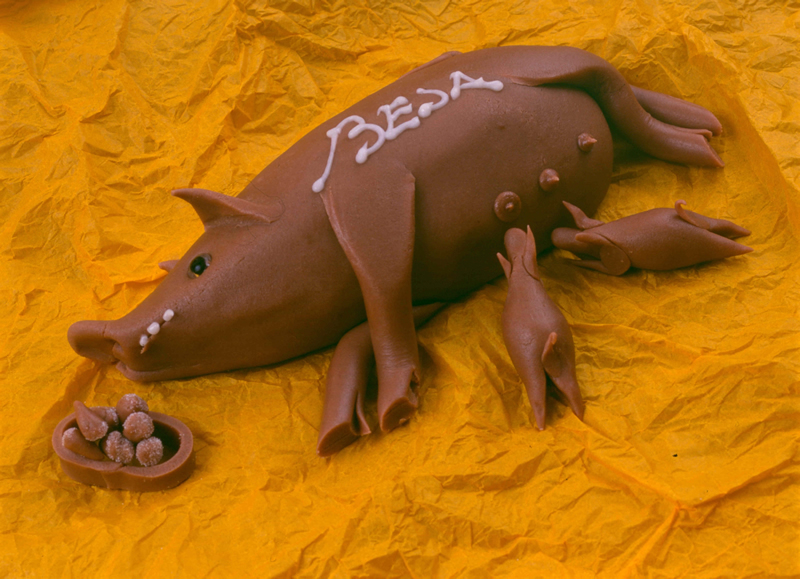
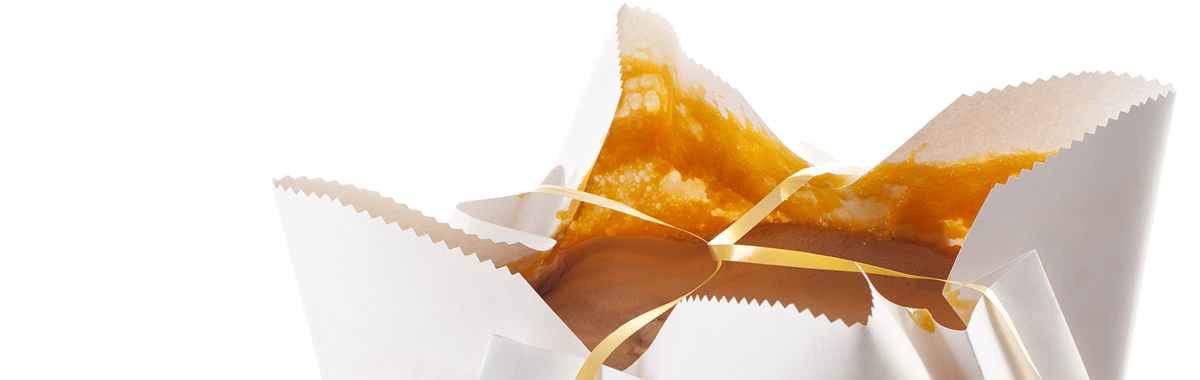
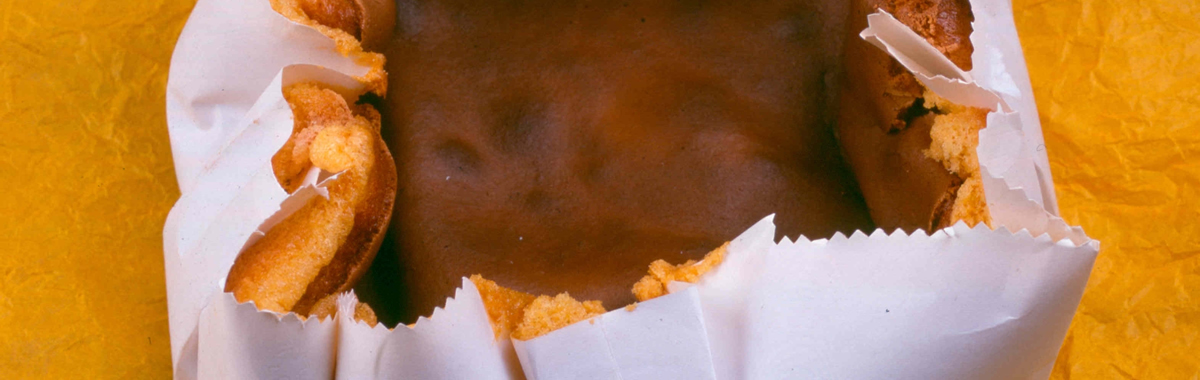
Description: Sweet made with marzipan colored in chestnut, by the addition of chocolate, filled with egg jam, gila jam and egg threads. You can also take bundles of eggs.
Region: Alentejo.
Other names: Porca de Beja.
Special feature: Almond jam with chocolate, set in the shape of a pig lying on its side on a lacy paper napkin. It can come in various sizes and shapes, with the largest being the most decorated. It sometimes appears in the shape of a sow suckling pigs and decorated with acorns made of the same dough.
History: As the pig is the animal that is primarily part of the diet of the Alentejo populations and since Christmas time is the time par excellence for slaughters, a Christmas sweet in the shape of a pig began to be manufactured many years ago in a pastry shop in Beja. Its weight varies from 1 kg to about 2 kg and it is set in brown marzipan, by the addition of chocolate, to have the color of the Alentejo pig. «... It consists of small pieces modeled in the shape of pigs..., filled with egg jam, has a chocolate coating and, as decoration, small branches of acorns and couplets related to the intention. It is usually presented in more or less decorated cardboard boxes...". This sweet was also described as a «treat» from the Convent of Paradise.
Use: As a sweet treat and dessert all year round. Widely used as a gift at Christmas time.
Know-how: As the recipe is a well-kept secret by the houses that manufacture it, it can be said that the pig is modeled on a sheet of white paper, alternating layers of egg threads, gila jam and egg jam (ovos moles). The filling is covered with a very smooth layer of brown-colored marzipan, giving it the shape of a lying pig. Two glass beads are stuck in the eye area and can be decorated, on the back, with holm oak leaves made of chocolate and with phrases alluding to what you want to celebrate.
Source: Produtos Tradicionais Portugueses, Lisboa, DGDR, 2001
