



 Português
  English (UK)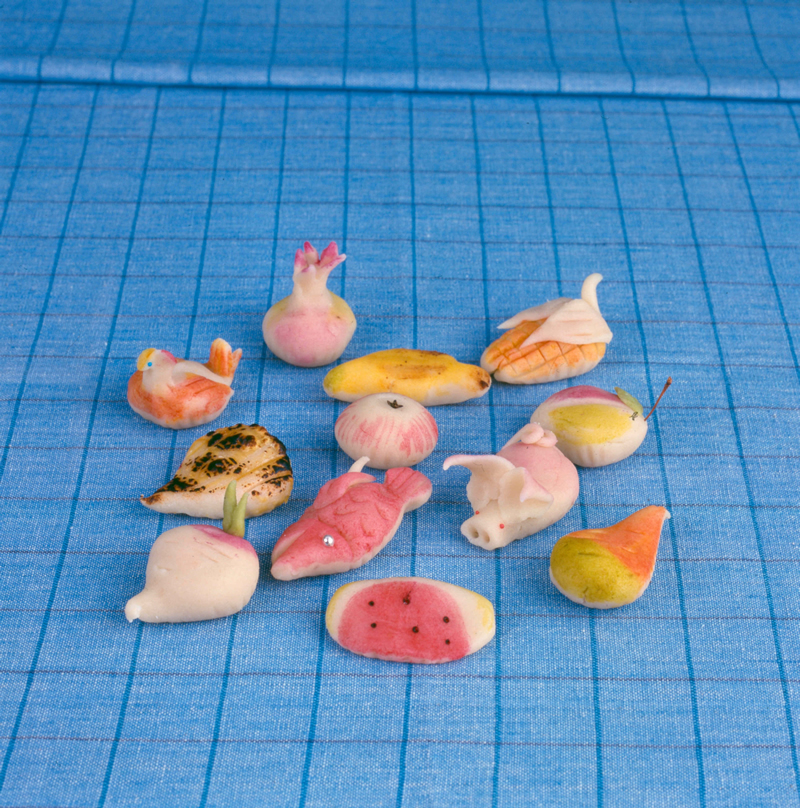
Description: The cakes are about 4 to 5 cm in diameter, dirty white in color and grainy in texture. They are prepared with a dough made with equal parts of grated almonds sugar, taking 1 or 2 egg whites to bind. The filling is sweet from soft eggs and made with sugar. The cakes weigh about 50 g.
Region: Algarve.
Other denominations: Queijinhos. Fruits of the Algarve. Almond Jams.
Variants: They are in the form of cheeses, hams, sausages, fruit baskets, etc., garnished with colouring matter or chocolate.
Particularity: The greatest particularity of these sweets is their amazing presentation, since they perfectly imitate the most varied fruits and vegetables, whole or sliced cheeses, etc. Their preparation requires enormous skill and many hours of specialized work, given the degree of perfection achieved.
History: Among the sweets of the Algarve, there is no choice... The best thing is to try them all and choose if you can. Small cakes, made with almond dough and filled with egg jam, are typical, which are thought to be of Arabic origin. It is believed that they originate from conventual sweets and that they have become traditional in the Algarve because this region is an important producer of almonds. Although these sweets are sold throughout the Algarve, their history and fame are closely linked to an old Algarve pastry shop, and especially to their owners. Thus, although the pastry shop only opened its doors to the public about 70 years ago, the primitive owner was already known as a famous confectioner long before that date. Its current fame is such that it is to this house that one turns when, on the occasion of large state banquets, one wants to present a work of confectionery art (such as, for example, during the visit of Queen Isabel or the Pope to Portugal). In 1918 sweets are already mentioned and, nowadays, anyone who goes to Portimão does not fail to pass by Pastelaria Almeida, if only to appreciate the art of its decoration.
Use: As a cherished treat and also as a delicate gift to take as a souvenir to friends.
Know-how: Grate the almonds very well and mix with sugar and egg white until malleable. Balls are made, opening a cavity to put the soft eggs. The balls are shaped again, rounded and finally a stroke is given to flatten and give the cheese shape or the shape you want. The decorations required by the piece to be prepared are added, such as tiny roots, leaves, stems, etc., also prepared with almond paste. In the past, and because dyes were not used, the most common forms were cheeses, hams and some other pieces that could be represented only with the addition of a little chocolate or by burning the sur-face of the jam. Once the sweets are made, they are coated in powdered sugar and placed in beaded paper boxes.
Source: Produtos Tradicionais Portugueses, Lisboa, DGDR, 2001
