

 Português
  English (UK)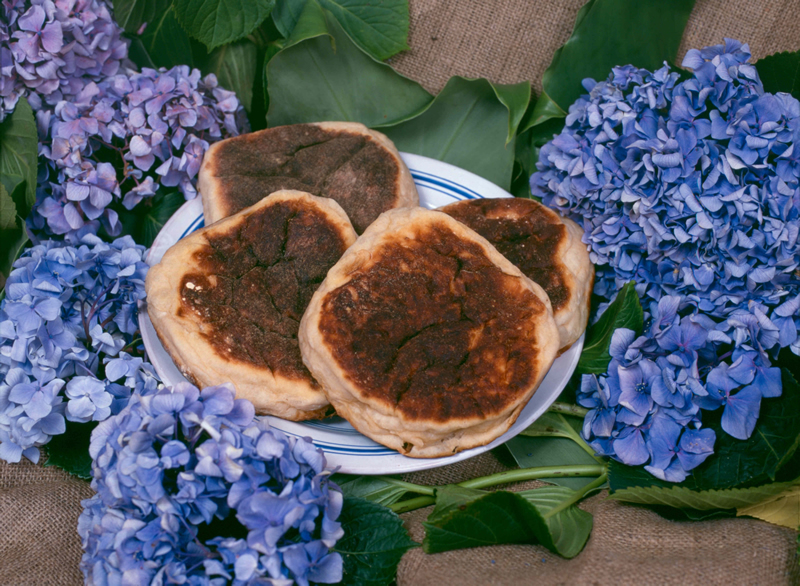
Description (dimensions, color, aroma, texture):
Definition of the geographical area of production: Faial Island, Azores.
Ingredients used: 1 kg of wheat flour; 150 g of sugar; 150 g of butter; 20 g of baker's yeast; 2.5 dl milk; 2 whole eggs; salt to taste.
Preparation: Sift the flour with the sugar into a bowl, make a hole in the middle and pour the yeast dissolved in a little warm milk there. Mix and add the melted butter. Then knead until you get a mixture with the consistency of bread dough. Let the dough rise until dawn. You then tend the orange-sized cakes with pieces of this dough, not rolling them, but shaping them by turning the edges inwards. Place them on floured towels, with the finish facing down. Cover and leave to rise again, for about 4 hours. Take each ball in turn and extend it with your hands so that they are like a 1 cm thick disc. Lightly sprin-kle the frying pan with flour and let it cook on both sides, reducing the heat halfway through cooking. These cakes can accompany the whole meal, serve for breakfast and snack with butter and fresh or sweet cheese.
Forms of commercialization: In general, it is presented in varieties of bread, in the accompaniment of the meal in the catering units with predominance in the parish of Furnas, however it can be found in any commercial area on the island of S. Miguel.
Year-round product availability: Available year-round.
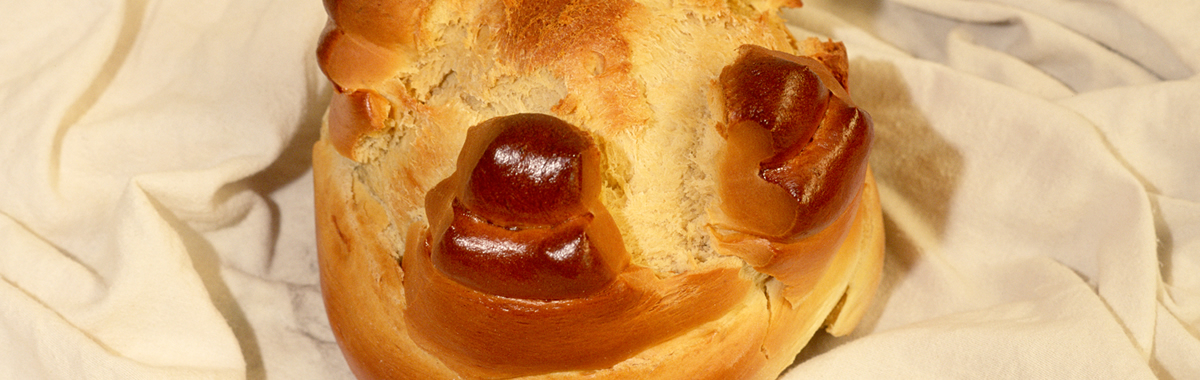
Product history: It has the name of a cake but can be considered a sweet bread. It goes very well with breakfast, snack and any gastronomic note. It is very common to consume it raw accompanied by tea or milk, crispy toast, when it is no longer daytime. Warm, spread with butter, fresh or soft cheese and jams, is another alternative. Its halfwhitish appearance, rounded in the shape of cheese, led the French to call it "gâteau-au fromage blanc". Much appreciated, it has become a great source of revenue and tourist dissemination for the parish of Furnas and S. Miguel. Although it is made throughout the archipelago, the records we found refer to it predominantly on the North Coast of the island of S. Miguel, Capelas, Santo António and Brittany, stripped of sugar and eggs, linked to the Lenten season of fasting, where the cake would have affirmed its name "lêvedo", made in a flat and round way, in clay frying pan. Today the bolo lêvedo of Furnas, called "the authentic one", to which eggs and sugar were added, is certainly the result of an innovation that took place in the mid-twentieth century, having gained space of identification and root with Furnas, to the point of becoming naturalized with that parish on the island of São Miguel.
