

 Português
  English (UK)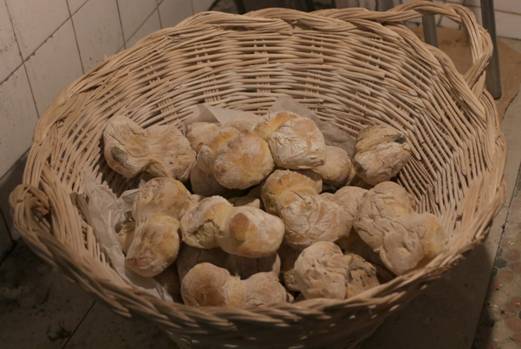
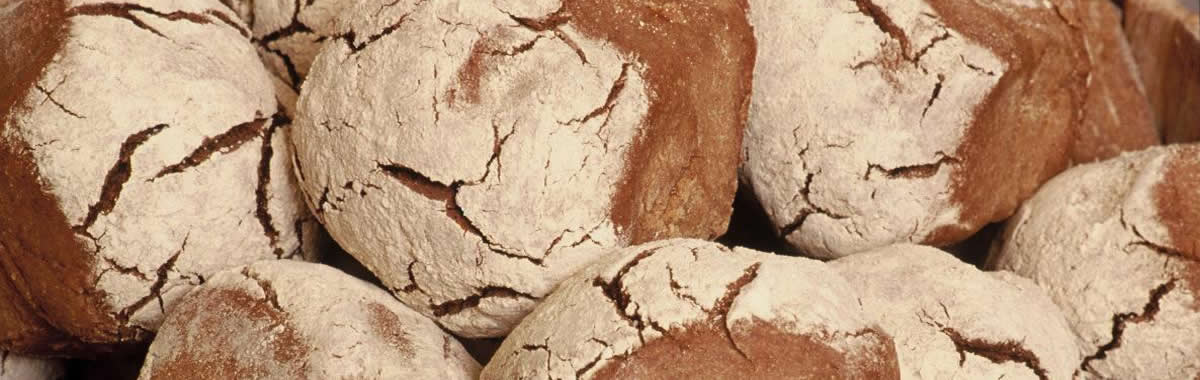
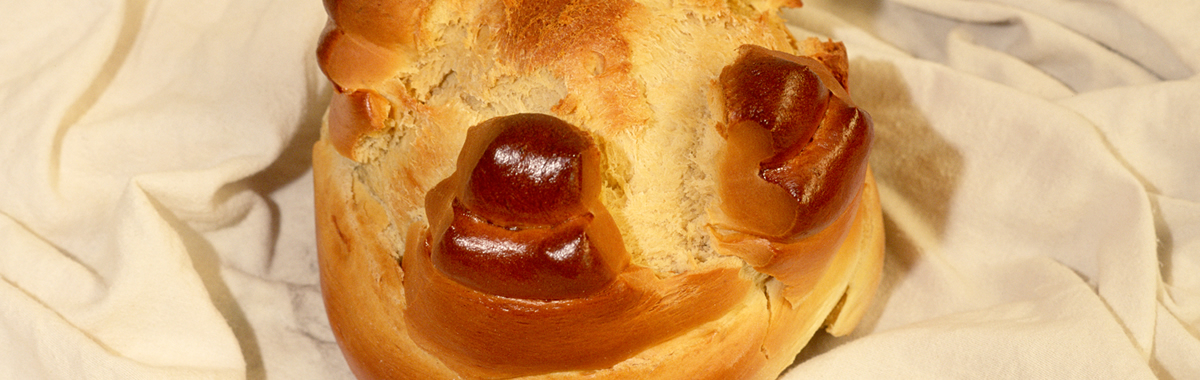
Description: Padas de Vale de Ílhavo are small wheat breads, formed by the junction of two "moletes" squeezed in the middle.
Special features: Padas are cooked in a wood-fired oven, with a characteristic shape and a golden, soft and lightly floured crust.
Region: Vale de Ílhavo.
Ingredients used: Wheat flour, salt, yeast and water.
Preparation: The process begins with the preparation of the flour, which consists of sieving it to remove any impurities. Then, the dough is mixed and kneaded by hand, in a bowl. After everything is well kneaded, the resulting product, the dough, is left to rise for a few hours. After being spun, "you give it flaps", letting it rest for a few moments, and then it is tened. The tendering operation consists of cutting the dough into pieces, which are shaped into balls. These are rested on trays covered with cloths, called "tentals", where the balls are cocooned and sprinkled with flour. With the oven already hot, the dough balls are placed on the shovel, giving them the shape known as Pada. After cooking, they are ready to be sold.
Know-how: Before placing the Padas in the oven, each of the dough balls is floured, and the ball is elongated and squeezed in the middle, between the thumb and forefinger. After being placed on the oven shovel, it is flattened with both hands.
Forms of commercialization: Traditional bakeries and markets in Vale de Ílhavo.
Product availability throughout the year: All year round. It should be noted that on Sundays the tradition of not baking bread is maintained.
Product history: The Ílhavo Valley stands out geographically for its proximity to the Bôco River (Ria de Aveiro Channel). Already during the seventeenth to nineteenth centuries, this region was characterized by having many levadas and watermills, and being conducive to the cultivation of cereals, so it is not surprising its deep-rooted and famous tradition of bread production.
The production of Padas de Vale de Ílhavo, essentially developed by female elements, is an ancestral knowledge, transmitted from mother to daughter, over several generations, and the respective utensils used in its artisanal confection are also transmitted.
The bakeries are, as in times gone by, located in the houses of the bakers, in a space reserved for this activity and are easily identifiable by the firewood, methodically stacked, visible from the outside.
Representativeness in local food: The Padas de Vale de Ílhavo are very appreciated, and it is common for local people to say that "the Bread of Vale de Ílhavo is eaten even without anything".
Source: DGADR, based on elements provided by the Municipality of Ílhavo and Barboff, M. et al (2017) “O Pão em Portugal”. Scribe-Produções Culturais, Lda., Lisboa.
Photo: Provided by Municipality of Ílhavo
